Atezolizumab verbetert event-free survival niet significant bij vroeg triple-negatief mammacarcinoom, NSABP B-59/GeparDouze
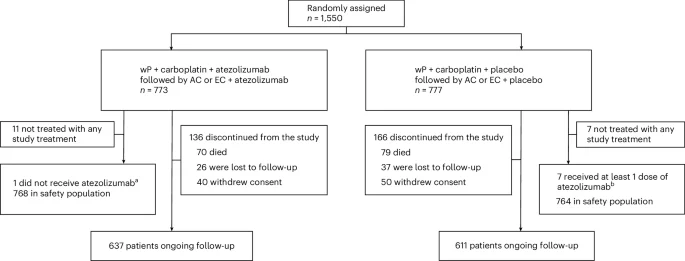
In het fase 3 NSABP B-59/GeparDouze-randomisatieonderzoek werden 1550 patiënten met stadium II-III triple-negatief mammacarcinoom behandeld met neoadjuvante chemotherapie met of zonder atezolizumab. De toevoeging van atezolizumab verbeterde event-free survival niet significant (HR 0,80; 95% BI 0,62-1,03; P = 0,083), hoewel een subgroep met klinische lymfeklierbetrokkenheid een signaal voor voordeel vertoonde (P-interactie = 0,039).
Immuungeactiveerde tumoren waren vaker bij atezolizumab (27,6% versus 11,4%), en exploratieve analyses wijzen op een profiel met basaalachtige immuungeactiveerde tumoren als potentiële selectiecriterium.
Deze resultaten betekenen dat atezolizumab niet routinematig kan worden toegepast in het vroege stadium, en dat de oncologische praktijk zich moet richten op biomarker-gestuurde patiëntselectie via tumorsubtyping en TIL-kwantificatie.
Abstract (original)
Triple-negative breast cancer (TNBC) is an aggressive subtype with an activated tumor immune microenvironment. The multicenter, multinational, double-blinded NSABP B-59/GeparDouze trial evaluated the addition of atezolizumab (atezo) (773 patients randomized) or placebo (777 patients) to sequential taxane-carboplatin-anthracycline-based neoadjuvant chemotherapy in stage II-III TNBC. The addition of atezo did not significantly improve the primary endpoint of event-free survival (EFS) (HR, 0.80 (95% CI, 0.062-1.03); stratified log-rank P = 0.083, 4-year EFS rates difference 3.3%). The HR for overall survival was 0.86 (95% CI, 0.62-1.19), with a 4-year benefit of 0.7%. Prespecified subgroup analyses suggested heterogeneity in EFS, with benefit of atezo in patients presenting with clinical lymph node involvement (Pinteraction = 0.039). Treatment-emergent adverse events with grades ≥3 were reported in 75.3% (atezo) versus 73.4% (placebo), and immune-related adverse events were reported in 27.6% (atezo) versus 11.4% (placebo). A total of 196 (25.5%) patients discontinued atezo and 143 (18.8%) patients discontinued placebo in the neoadjuvant phase. In an exploratory mRNA-based subset analysis, patients with basal-like immune-activated tumors may have benefited from atezo. TNBC subtyping to identify basal-like immune-activated tumors and quantification of tumor-infiltrating lymphocytes to identify tumors with high tumor-infiltrating lymphocyte counts could be a promising strategy to identify patients who benefit from the addition of immune checkpoint inhibitors to neoadjuvant chemotherapy. ClinicalTrials.gov registration: NCT03281954 .
Dit artikel is een samenvatting van een publicatie in Nature medicine. Voor het volledige artikel, alle details en referenties verwijzen wij u naar de oorspronkelijke bron.
Lees het volledige artikelDOI: 10.1038/s41591-026-04565-6