Vertrouwen in zorg en wetenschap bepaalt waardering voor multicarcinoom-vroege detectietest
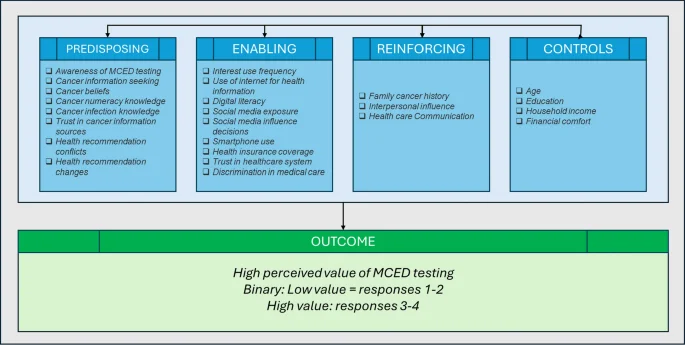
Een nationale Amerikaanse enquête onder 6.728 volwassenen onderzocht welke factoren de waardering van multicarcinoom-vroege detectietesten (MCED) bepalen. Uit de cross-sectionele analyse bleek dat 74,9% van de deelnemers MCED-screening als zeer waardevol beschouwde.
De sterkste voorspellers waren vertrouwen in de huisarts (OR 1,89), wetenschap (OR 1,80) en het zorgstelsel (OR 1,64), aangevuld met cancerinformatiezoekgedrag en toegang tot digitale gezondheidsbronnen.
Voor de klinische praktijk en screeningprogramma's benadrukt dit onderzoek dat het succes van nieuwe MCED-tests sterk afhankelijk is van publiek vertrouwen en eerlijke communicatie, eerder dan van zuiver medische kenmerken.
Abstract (original)
BACKGROUND: Multi-cancer early detection (MCED) tests present a paradigm transform in cancer screening by detecting multiple cancer types from one blood sample. While studies have shown high levels of public interest in MCED screening, little is known about factors shaping individuals' perception of the emerging technology. Guided by the PRECEDE-PROCEED framework, we aimed to identify factors associated with the perception of value of MCED testing among American adults. METHODS: We conducted a cross-sectional secondary analysis of the Health Information National Trends Survey cycle 7 (HINTS 7) to identify factors associated with the perceived value of MCED screening. After removing respondents with missing outcome data, our final sample size was 6,728. Using the PRECEDE-PROCEED framework, candidate predictors were grouped into predisposing, reinforcing, and enabling factors. We used descriptive, survey-weighted analyses, spearman correlation analyses, survey-weighted multivariable logistic regression, and supervised machine learning analyses (logistic regression and random forest) to explore the associations. RESULTS: Overall, 74.9% of the sample perceived MCED testing as very valuable. Trust-related domains showed the strongest associations with the outcome, including trust in physicians (OR = 1.89), trust in science (OR = 1.80), and trust in the healthcare system (OR = 1.64). Cancer information seeking (OR = 1.59), online health information use (OR = 1.63), smartphone access (OR = 1.54), cancer fatalistic beliefs (OR = 1.52), trust in government (OR = 1.50), knowledge of hepatitis B as a cancer risk factor (OR = 1.48), and family history of cancer (OR = 1.45) were also significantly associated with higher perceived value. Machine learning analyses demonstrated consistent predictor rankings, highlighting trust and health information engagement as the most influential determinants. CONCLUSIONS: The value of MCED screening was largely driven by trust, cancer information seeking, and access to healthcare and health information resources. Our study highlights the efficacy of the PRECEDE-PROCEED approach to studying factors associated with complex health outcomes. Future implementation strategies should prioritize equitable communication, strengthen public trust, and improve access to reliable health information to facilitate informed decision-making regarding MCED testing.
Dit artikel is een samenvatting van een publicatie in Cancer causes & control : CCC. Voor het volledige artikel, alle details en referenties verwijzen wij u naar de oorspronkelijke bron.
Lees het volledige artikelDOI: 10.1007/s10552-026-02242-0