Schijnbaar nadelige overleving na neoadjuvante chemotherapie bij borstkanker verklaarbaar door selectiebias
Een retrospectieve single-center cohortstudie van 461 vrouwen met borstkanker onderzocht de prognostische waarde van neoadjuvante chemotherapie (NACT). Na statistische correctie voor tumorstadium verdween het schijnbaar nadelige effect van NACT op de overleving (HR 1,6; p=0,17), wat aantoont dat het effect voornamelijk wordt veroorzaakt door confounding by indicatie.
Onafhankelijke prognostische factoren waren stadium III-IV (HR 3,9), triple-negatieve tumoren (HR 2,4) en adjuvante radiotherapie (HR 0,32). Deze bevinding benadrukt dat oncologen en onderzoekers zorgvuldig moeten corrigeren voor selectiebias bij het evalueren van NACT, om onterechte terughoudendheid tegen deze standaardbehandeling te voorkomen.
Abstract (original)
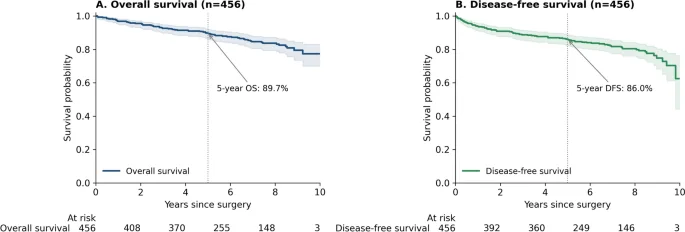
PURPOSE: Neoadjuvant chemotherapy (NACT) is reserved for tumours with a worse prognosis, introducing confounding by indication. Using sequentially adjusted Cox models to display confounding step by step, we assessed prognostic factors and the role of neoadjuvant therapy in a single-centre breast cancer cohort. METHODS: Retrospective study of 461 women treated at a single Spanish hospital (2016-2018) and followed to March 2026 (median 7.3 years; 456 in survival analyses). Overall (OS) and disease-free survival (DFS) were estimated by the Kaplan-Meier and Cox regression methods; proportional hazards were checked with Schoenfeld residuals and missing data handled by multiple imputation. RESULTS: Five-year OS and DFS were 89.7% and 86.0%. Independent prognostic factors were stage III-IV (HR 3.9), triple-negative subtype (HR 2.4) and adjuvant radiotherapy (HR 0.32). The apparent adverse effect of neoadjuvant therapy (univariable HR 2.35) disappeared after stage adjustment (HR 1.6; p = 0.17), with the same pattern for DFS; treated women differed chiefly in stage III-IV (60% vs. 14%; standardised mean difference 1.09). Recovering missing histological grade from source reports abolished its apparent prognostic effect (HR 1.40, 0.82-2.39). The triple-negative excess risk was concentrated in the first three years (HR 4.8 vs 0.4; interaction p = 0.020). CONCLUSIONS: After adjustment for stage and tumour burden, the apparent adverse effect of neoadjuvant therapy is largely explained by confounding by indication rather than treatment although the small treated subgroup cannot exclude a modest residual effect. Sequentially adjusted Cox models display the confounding pathway explicitly, complementing propensity-score approaches.
Dit artikel is een samenvatting van een publicatie in Clinical & translational oncology : official publication of the Federation of Spanish Oncology Societies and of the National Cancer Institute of Mexico. Voor het volledige artikel, alle details en referenties verwijzen wij u naar de oorspronkelijke bron.
Lees het volledige artikelDOI: 10.1007/s12094-026-04563-7