Mortaliteit multiple myeloom daalt in VS, aanhoudende ongelijkheid tussen bevolkingsgroepen
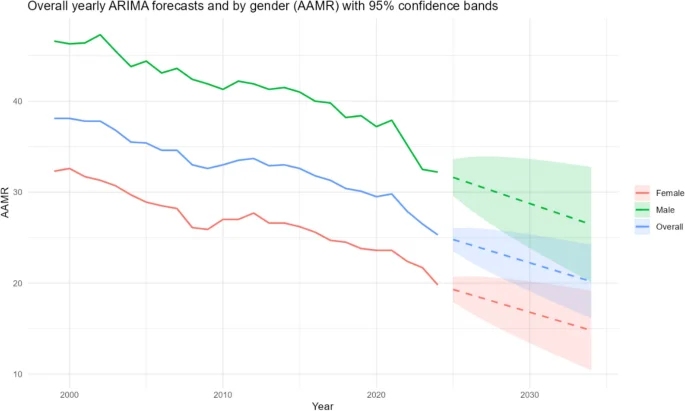
Een nationaal ecologisch onderzoek analyseerde sterftecijfers voor multiple myeloom in de Verenigde Staten van 1999 tot 2024 en projecteerde de trends tot 2034. De leeftijdsgecorrigeerde mortaliteit daalde van 37,6 naar 25,1 per miljoen inwoners, met een versnelde daling na 2012.
Zwarte patiënten hadden in 2024 meer dan dubbele sterftecijfers vergeleken met witte patiënten (48,0 versus 23,5 per miljoen), evenals mannen en inwoners van het zuiden en landelijke gebieden. Deze bevindingen benadrukken dat therapeutische vooruitgang niet automatisch leidt tot gelijke zorgresultaten; klinische aandacht voor vroegtijdige diagnose, gelijke toegang tot behandelingen en betere representatie in onderzoek blijft essentieel.
Abstract (original)
BACKGROUND: Despite major advances in multiple myeloma (MM) therapy including proteasome inhibitors, immunomodulatory agents, anti-CD38 monoclonal antibodies, and chimeric antigen receptor T-cell therapies the extent to which these innovations have translated into equitable population-level mortality reductions across U.S. demographic and geographic subgroups remains unclear. We evaluated national MM mortality trends from 1999-2024 and projected trajectories through 2034, stratified by sex, age, race/ethnicity, census region, urbanization, and place of death. METHODS: MM-related deaths were identified from the CDC Wide-Ranging Online Data for Epidemiologic Research (CDC WONDER) database using ICD-10 code C90.0 from 1999-2024. Age-adjusted mortality rates (AAMRs) per 1,000,000 population were calculated using the 2000 U.S. standard population. Temporal trends were assessed using joinpoint regression (Joinpoint Regression Program v6.0.1, National Cancer Institute), generating annual percent changes (APCs) and average annual percent changes (AAPCs). Statistical significance was defined as p<0.05. Autoregressive Integrated Moving Average (ARIMA) models selected by Akaike Information Criterion were used to project national and subgroup-specific AAMRs through 2034 with 95% confidence intervals. RESULTS: From 1999-2024, overall MM-related AAMRs declined from 37.6 to 25.1 per 1,000,000 population (AAPC -1.8%; 95% CI -2.1 to -1.5; p<0.001). Mortality decline accelerated significantly after 2012 (APC -3.2%; p<0.001), coinciding with widespread adoption of newer therapeutic agents. Males consistently demonstrated higher AAMRs than females (32.4 vs 19.8 per 1,000,000 in 2024). Black or African American individuals experienced the highest mortality burden throughout the study period, with 2024 AAMRs more than double those of White individuals (48.0 vs 23.5 per 1,000,000). Adults aged ≥65 years had the highest mortality burden (175 per 1,000,000 in 2024, down from 230 in 1999). The South and nonmetropolitan regions consistently showed higher mortality rates than other regions and metropolitan areas. ARIMA projections estimate continued national decline to approximately 20.0 per 1,000,000 (95% CI 17.5-22.5) by 2034, although racial, geographic, and sociodemographic disparities are projected to persist. CONCLUSIONS: MM mortality in the United States has declined substantially over the past 25 years, with accelerated improvement after 2012 consistent with the impact of novel therapies. However, major inequities by race, sex, age, geography, and rurality remain and are projected to persist through 2034. Reducing these disparities will require not only continued therapeutic advances but also equitable access to care, earlier diagnosis, and improved representation of underserved populations in clinical research.
Dit artikel is een samenvatting van een publicatie in Cancer causes & control : CCC. Voor het volledige artikel, alle details en referenties verwijzen wij u naar de oorspronkelijke bron.
Lees het volledige artikelDOI: 10.1007/s10552-026-02253-x