Cognitief herstel na axicabtagene ciloleucel is sterker bij ouderen dan bij jongere patiënten met grootcellig lymfoom
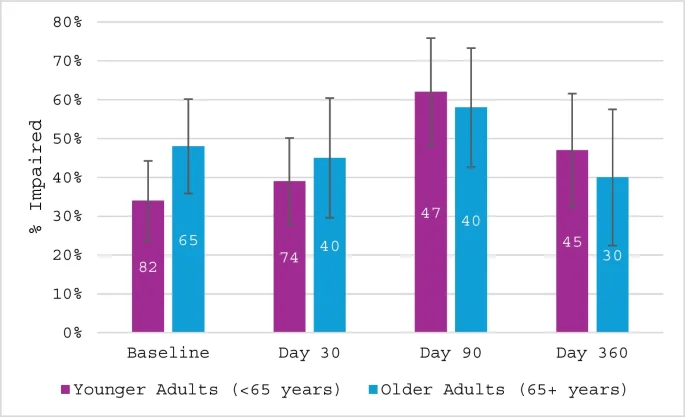
Deze cohortstudie onderzocht cognitieve veranderingen bij 155 patiënten met grootcellig B-cel-lymfoom die behandeld werden met axicabtagene ciloleucel, met een vergelijking tussen patiënten van 65 jaar en ouder versus jongere patiënten.
Hoewel ouderen vaker cognitieve beperkingen vertoonden vóór de infusie (48% versus 34%), bleken zij tijdens het eerste jaar na behandeling significanter te herstellen in onder meer direct en vertraagd verbale geheugen (p < 0,01).
De bevindingen suggereren dat CAR T-celtherapie minder schadelijk kan zijn voor de neurocognitieve prestaties van ouderen dan aanvankelijk werd aangenomen. Voor de klinische praktijk betekent dit dat ouderen niet automatisch uitgesloten moeten worden van CAR T-celtherapie op basis van cognitief risico, maar wel structureel monitoren op neurotoxiciteit en herstel vereist blijft.
Abstract (original)
Chimeric antigen receptor (CAR) T-cell therapy, including axicabtagene ciloleucel (axi-cel), is efficacious for older patients. However, patients aged 65 + are at risk for more severe neurotoxicity after infusion than younger patients, and post-infusion cognitive outcomes in older patients are unknown. This study assessed changes in objective neurocognitive performance in patients age 65 + compared to those younger than 65 in the first year after axi-cel and examined clinical factors influencing these changes. In patients with large B-cell lymphoma, neuropsychological assessments were conducted prior to initiation of axi-cel and at 30, 90, and 360 days after infusion. Mixed effects models were used to investigate age differences in changes in overall cognition (e.g., total neuropsychological performance [TNP]) and specific domains (i.e., attention, executive function, verbal ability, immediate and delayed memory, and visuospatial abilities). Among 155 participants (63% male, 90% White), older adults (n = 69) were more likely than younger adults (48% vs. 34%, p < 0.05) to demonstrate overall neurocognitive impairment before infusion. However, older adults demonstrated greater recovery of cognitive abilities (e.g., immediate verbal memory and delayed memory) over time (ps < 0.01). These results suggest that CAR T-cell therapy may have a less detrimental impact on neurocognitive performance in older patients compared to younger patients.
Dit artikel is een samenvatting van een publicatie in Supportive care in cancer : official journal of the Multinational Association of Supportive Care in Cancer. Voor het volledige artikel, alle details en referenties verwijzen wij u naar de oorspronkelijke bron.
Lees het volledige artikelDOI: 10.1007/s00520-026-11169-w