Sterke TROP2-expressie ondersteunt doelwitfunctie voor ADC-therapie bij slokdarmkanker
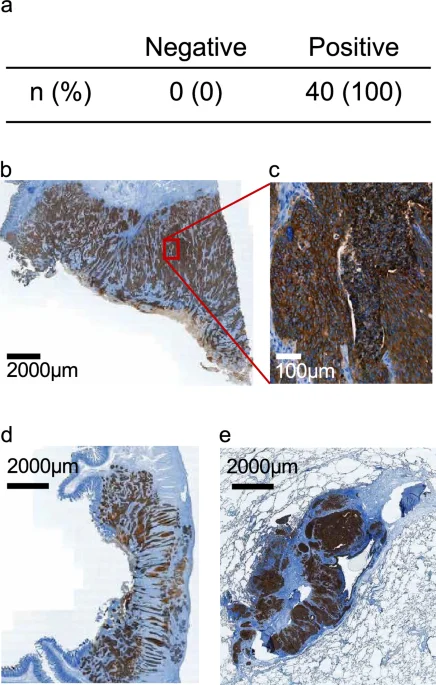
Een gecombineerde analyse van TCGA-gegevens en een institutioneel cohort (n=70) onderzocht de expressie van TROP2 bij squameus slokdarmcarcinoom. TROP2 toonde op eiwit- en RNA-niveau een uniforme, sterke expressie in primaire en metastatische tumoren.
Een hoge TACSTD2-expressie ging gepaard met een trend naar een kortere totale overleving, zonder significant verschil in ziektevrije overleving. De consistente expressie ondersteunt de potentie van TROP2 als therapeutisch doelwit voor antilichaam-gedreven conjugaten (ADC's), hoewel grotere cohorts nodig zijn om de prognostische waarde en klinische toepasbaarheid te bevestigen.
Abstract (original)
BACKGROUND: Esophageal squamous cell carcinoma (ESCC) has a poor prognosis, and new therapeutic targets are required. Antibody-drug conjugates (ADCs) are a promising therapeutic modality that selectively delivers cytotoxic payloads to tumors via cell-surface antigens. Tumor-associated calcium signal transducer 2 (TROP2, TACSTD2) has shown therapeutic potential as an ADC target in several malignancies; however, its clinical significance in ESCC remains unclear. METHODS: An institutional cohort of ESCC patients treated at Kindai University was retrospectively evaluated by immunohistochemistry (n=70) and RNA sequencing (n=27). TACSTD2 copy number alterations, RNA expression, and survival were analyzed using the Cancer Genome Atlas (TCGA) ESCC dataset. IHC was assessed in both resected and biopsy specimens, including metastatic lesions. Survival analyses were performed, stratifying patients by cohort-specific median TACSTD2 expression levels. RESULTS: Immunohistochemistry analysis demonstrated uniformly strong TROP2 expression in all evaluable primary and metastatic lesions. In the TCGA dataset, TACSTD2 mRNA expression was consistently high, irrespective of copy-number status, and was comparable to or higher than that observed in non-small cell lung cancer and breast cancer, tumor types in which TROP2-targeted ADCs are clinically active. The TACSTD2 high-expression group showed a trend toward worse overall survival in both the institutional and the TCGA cohort, whereas disease-free survival was similar. CONCLUSIONS: TROP2/TACSTD2 is strongly and consistently expressed in ESCC at the protein and RNA levels, despite infrequent gene amplification, supporting its feasibility as a therapeutic target. High expression shows a trend toward poorer overall survival, warranting validation in larger cohorts.
Dit artikel is een samenvatting van een publicatie in Esophagus : official journal of the Japan Esophageal Society. Voor het volledige artikel, alle details en referenties verwijzen wij u naar de oorspronkelijke bron.
Lees het volledige artikelDOI: 10.1007/s10388-026-01257-5