TEAS en zelfacupressuur verbeteren symptoomtrajecten bij borstkankerpatiënten tijdens chemotherapie
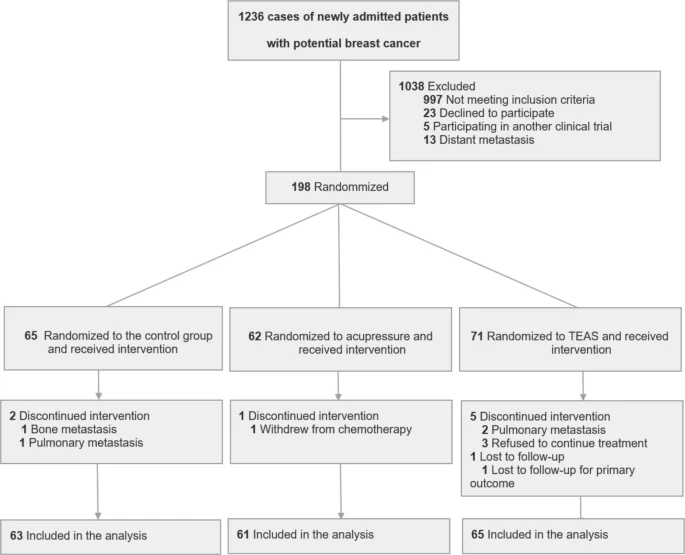
In een secundaire analyse van een gerandomiseerde gecontroleerde trial (n=189) werd onderzocht of transcutane elektrische acupunctuurstimulatie (TEAS) en zelfacupressuur (SA) het meerdimensionale symptoomtraject van borstkankerpatiënten tijdens chemotherapie beïnvloeden.
De analyse identificeerde twee trajecten: een groep met aanhoudend hoge symptoomlast en een groep met lage symptoomlast en verbetering. Zowel TEAS als SA verhoogden significant de kans op het gunstigere traject, waarbij de gemiddelde behandelingseffecten respectievelijk 0,147 (TEAS) en 0,176 (SA) bedroegen.
Deze bevindingen suggereren dat beide niet-farmacologische interventies nuttig kunnen zijn in de ondersteunende zorg om chemotherapiegerelateerde bijwerkingen zoals misselijkheid, angst en slaapproblemen op de lange termijn te verlichten.
Abstract (original)
BACKGROUND: Chemotherapy for breast cancer often induces multidimensional adverse reactions such as nausea and vomiting, anxiety, depression, and sleep disturbances. These symptoms are interrelated and may evolve dynamically, impacting patients' treatment outcomes and quality of life. As non-pharmacological interventions, transcutaneous electrical acupoint stimulation (TEAS) and self-acupressure (SA) have shown potential in alleviating symptoms. However, their long-term effects on the joint developmental trajectories of these multidimensional symptoms (nausea and vomiting, anxiety, depression, and sleep disturbances) remain unclear. OBJECTIVE: This study aimed to identify potential trajectory class of multidimensional adverse reactions in breast cancer patients undergoing chemotherapy and to explore the differential effects of TEAS and SA on different trajectory subgroups. METHODS: This was a secondary analysis of a randomized controlled trial. A total of 189 breast cancer patients receiving chemotherapy were included. The Group-Based Multi-Trajectory Model (GBMTM) was employed to identify joint developmental trajectories of acute/delayed chemotherapy-induced nausea and vomiting (CINV), anxiety, depression, and sleep quality during chemotherapy. Subsequently, causal forest was used to analyze the average treatment effects (ATE) of TEAS (vs. control group) and SA (vs. control group) on patients' symptom trajectory. RESULTS: Multidimensional adverse reactions were classified into two heterogeneous trajectories: a "High Symptom Burden-Persistent (HSBP)" type (n = 101) and a "Low Symptom Burden-Relieving (LSBR)" type (n = 88). The persistent high incidence of acute CINV contrasted sharply with the comprehensive relief of other symptoms in the latter group. Causal forest suggested that both TEAS and SA significantly increased the probability of patients being classified into the "LSBR" trajectory. The ATE was 0.147 (95% CI: 0.143, 0.151) for TEAS, slightly lower (P < 0.05) than 0.176 (95% CI: 0.162, 0.190) for SA. CONCLUSION: Multidimensional adverse reactions in breast cancer patients undergoing chemotherapy exhibit heterogeneity in their trajectories. Both TEAS and SA were associated with a higher probability of patients being classified into a more favorable symptom trajectory-LSBR. The multidimensional trajectory identification with treatment effect estimation may serve as a useful analytical strategy for future longitudinal research in cancer chemotherapy-induced adverse reactions symptom management. CLINICAL TRIAL REGISTRATION: ChiCTR2300077667 (Chinese Clinical Trial Registry, https://www.chictr.org.cn/ ), Registered 15 November 2023.
Dit artikel is een samenvatting van een publicatie in Supportive care in cancer : official journal of the Multinational Association of Supportive Care in Cancer. Voor het volledige artikel, alle details en referenties verwijzen wij u naar de oorspronkelijke bron.
Lees het volledige artikelDOI: 10.1007/s00520-026-11168-x