Roboterondersteunde tepelsparingmastectomie biedt cosmetische voordelen, maar mist nog prospectieve validatie
Deze narratieve review analyseert de huidige literatuur over roboterondersteunde tepelsparingmastectomie (R-NSM) bij borstkankerpatiënten. De techniek biedt voordelen zoals driedimensionale visualisatie en verbeterde instrumentdichtheid, wat resulteert in acceptabele korte- tot middentermijnveiligheid en verbeterde cosmetische uitkomsten, zij het tegen langere operatietijden en hogere kosten.
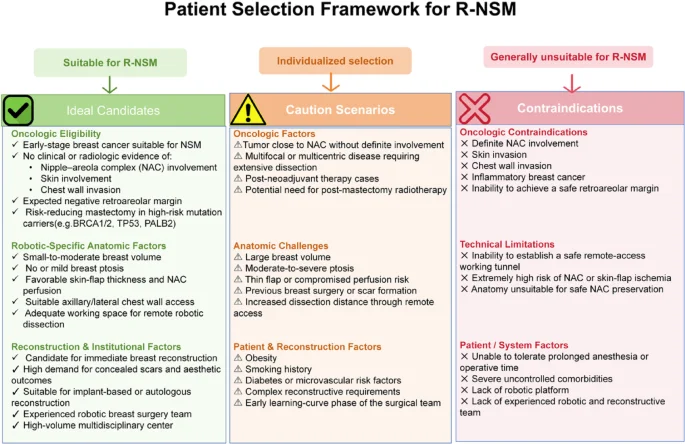
Voor de klinische praktijk betekent dit dat R-NSM een waardevolle ontwikkeling is in minimally invasive borstchirurgie, maar de inzet blijft voorbehouden aan geselecteerde patiënten tot grotere prospectieve studies de lange-termijn oncologische veiligheid en kosteneffectiviteit hebben bevestigd.
Abstract (original)
Nipple-sparing mastectomy (NSM) has emerged as an important advancement in breast surgery, offering significant improvements in postoperative aesthetic outcomes and patient quality of life while maintaining oncologic safety. However, conventional open and endoscopic approaches to NSM remain associated with technical limitations, including restricted surgical exposure, challenges in confined operative spaces, and the need for remote and concealed incisions. In recent years, robotic nipple-sparing mastectomy (R-NSM) has been increasingly introduced into clinical practice. With its advantages of three-dimensional magnified visualization, enhanced instrument dexterity, and stable operative control, R-NSM has demonstrated potential benefits for precise dissection under complex anatomical conditions. Given the substantial heterogeneity among R-NSM studies in terms of surgical techniques, study designs, and outcome assessments, this review adopts a narrative review approach to provide a structured synthesis of the current literature. We particularly focus on the technical characteristics of R-NSM, including improved visualization, enhanced instrument flexibility, and optimized operative stability, and summarize the available clinical evidence regarding oncologic safety, perioperative outcomes, and aesthetic results. Current evidence suggests that R-NSM provides acceptable short- to mid-term safety profiles and may offer favorable outcomes in selected perioperative and aesthetic parameters. Nevertheless, its application remains limited by prolonged operative time, increased procedural costs, and other resource-related considerations. Moreover, the existing evidence is largely derived from retrospective studies and multicenter observational experiences, with limited long-term follow-up and high-quality prospective validation. Overall, R-NSM represents an important direction in the evolution of minimally invasive and precision-oriented breast surgery. However, its true clinical value regarding long-term oncologic safety and sustained patient benefit remains to be established. Future multicenter, large-scale, and prospective studies with extended follow-up are warranted to further define its clinical role and identify the patient populations most likely to benefit.
Dit artikel is een samenvatting van een publicatie in Updates in surgery. Voor het volledige artikel, alle details en referenties verwijzen wij u naar de oorspronkelijke bron.
Lees het volledige artikelDOI: 10.1007/s13304-026-02838-w