Real-world ESR1-testfrequenties blijven laag bij gemetastaseerd ER+/HER2- mammacarcinoom
Een retrospectieve cohortstudie met bijna 9000 patiënten met ER+/HER2- gemetastaseerd mammacarcinoom onderzocht de real-world praktijk rondom ESR1-mutatietesten en de prevalentie over verschillende behandellijnen.
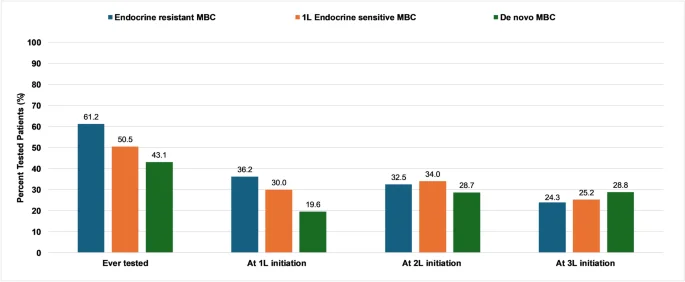
De testfrequentie bleef onder de richtlijnadviezen, variërend van 19,6% bij start van eerste lijn tot 61,2% bij endocriene resistentie. Mutatiepositiviteit nam toe van 2,1% tot 24,7% in eerste lijn naar circa 30% in tweede lijn en 40% in derde lijn, terwijl weefselsamples nog steeds vaker worden gebruikt dan bloed.
Deze data onderstrepen de klinische noodzaak van systematische ESR1-testen bij progressie, met een duidelijke aanbeveling om vaker op bloed gebaseerde diagnostiek toe te passen om de richtlijnconformiteit en patiëntselectie voor gerichte therapie te verbeteren.
Abstract (original)
BACKGROUND: The estrogen receptor-positive, human epidermal growth factor receptor 2-negative metastatic breast cancer (MBC) treatment landscape continues to evolve with targeted therapy development. Estrogen receptor 1 (ESR1) testing is recommended at recurrence or each progression event to identify patients for effective therapies. However, there is limited information on testing and mutation patterns in the real world that can inform patient identification in the clinic. METHODS: A retrospective observational study among patients with estrogen receptor-positive, human epidermal growth factor receptor 2-negative MBC who initiated first line (1L) therapy with aromatase inhibitors or selective estrogen receptor degraders ± CDK4/6 inhibitors from 1 January, 2020 to 31 March, 2025, using the Flatiron Health Research Database was conducted. ESR1 testing and mutation positivity rates at 1L to third line initiation, stratified by endocrine-resistant, 1L endocrine-sensitive, and endocrine-sensitive/de novo MBC were descriptively reported. RESULTS: Overall testing rates varied across subgroups, with one or more ESR1 test per patient in 61.2% of patients with endocrine-resistant MBC (n = 2152), 50.5% in patients with 1L endocrine-sensitive MBC (n = 827), and 43.1% in patients with endocrine-sensitive/de novo MBC (n = 5772). Testing rates at 1L initiation were 36.2% in endocrine-resistant MBC and 19.6% in endocrine-sensitive/de novo MBC. Testing rates were approximately 32% at second line and 25% at third line across subgroups. ESR1 mutation positivity (ESR1m+) rates varied by subgroup at 1L initiation and were highest among patients with endocrine-resistant MBC (24.7%), followed by patients with 1L endocrine-sensitive MBC (6.9%) and patients with endocrine-sensitive/de novo MBC (2.1%). All groups had ESR1m+ rates around 30% at second line initiation and 40% at third line initiation. In an exploratory analysis, ~ 60% of ESR1 tests during 1L were conducted in tissue and ~ 40% in blood. CONCLUSIONS: In this population, real-world ESR1 testing rates were low. One in four patients with endocrine-resistant MBC were ESR1m+ at 1L initiation, ~ 30% were ESR1m+ at second line across subgroups, and ~ 40% were ESR1m+ at third line across subgroups. More blood-based testing at recurrence and progression is recommended in the real world to align with guideline recommendations as ESR1m detection is more sensitive in blood than in tissue.
Dit artikel is een samenvatting van een publicatie in Molecular diagnosis & therapy. Voor het volledige artikel, alle details en referenties verwijzen wij u naar de oorspronkelijke bron.
Lees het volledige artikelDOI: 10.1007/s40291-026-00876-z