Postmenopauze en hoog Ki-67 voorspellen pathologische complete respons bij triple-negatief borstkanker
In een cohort van 90 vrouwen met stadium IIA-IIIB triple-negatief borstkanker onderzochten onderzoekers welke klinische, pathologische en radiologische parameters de respons op neoadjuvante chemotherapie voorspellen en de vijfjarige overleving beïnvloeden.
Postmenopauzale status en een hoog Ki-67-index in het initiële biopsiemateriaal bleken de sterkste voorspellers voor een pathologische complete respons (pCR), waarbij MRI na chemotherapie eveneens significante voorspellende waarde had (p = 0,027 tot 0,0001).
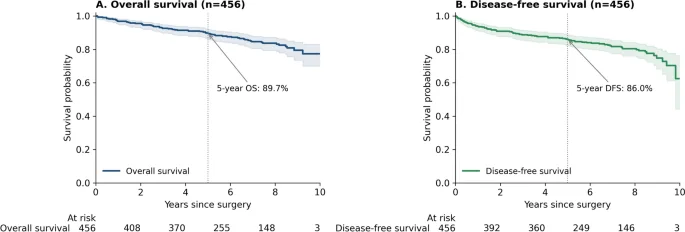
Het behalen van een pCR, de pathologische lymfeklierstatus, necrose en het Ki-67-niveau in residuweefsel correleerden significant met verbeterde vijfjarige ziektevrije en totale overleving. Deze bevindingen onderstrepen de prognostische waarde van posttherapeutische Ki-67-metingen en MRI-controles voor risicoadaptieve follow-up en behandelstrategieën bij deze agressieve subgroep.
Abstract (original)
INTRODUCTION: Triple-negative breast cancer (TNBC) represents a biologically aggressive subtype characterized by the absence of estrogen receptor, progesterone receptor, and HER2 expression. TNBC accounts for approximately 15% of all breast cancers and represents a heterogeneous group of diseases. The aim of this thesis was to investigate the sociodemographic, clinical, pathological, and radiological characteristics of patients with TNBC, their response to neoadjuvant chemotherapy (NACT) regimens, the factors influencing this response, and the disease-related variables affecting disease-free survival (DFS) and overall survival (OS). METHODS: The study consisted of 90 female patients, age between 30 and 65 years, diagnosed with stage IIA-IIIB TNBC, between December 2012 and September 2017. All patients received treatment protocols starting with NACT and subsequently underwent surgery performed in the same clinic. RESULTS: Postmenopausal status and high ki-67 values at biopsy were found to be the strongest predictors of achieving a pathological complete response (pCR). Magnetic resonance imaging (MRI) performed after NACT and prior to surgery had the highest predictive value in assessing pCR (p = 0.027, p = 0.036, and p = 0.0001, respectively). Pretreatment tumor size, presence of pCR, and post-surgical ki-67 values were statistically associated with 5-year OS. Presence of pCR, pathological nodal stage, necrosis, and post-surgical ki-67 values were significantly correlated with 5-year DFS. CONCLUSION: In patients with TNBC, achieving pCR after NACT and detecting low ki-67 values in residual tumors were associated with improved DFS and OS.
Dit artikel is een samenvatting van een publicatie in Breast care (Basel, Switzerland). Voor het volledige artikel, alle details en referenties verwijzen wij u naar de oorspronkelijke bron.
Lees het volledige artikelDOI: 10.1159/000552361