Nomogram met CA125 en CA153 voorspelt recidiefkans bij jonge borstkankerpatiënten

Een retrospectieve single-center studie ontwikkelde een voorspellend model voor recidief bij 411 vrouwen jonger dan 40 jaar met borstkanker. Het nomogram integreert preoperatieve CA125- en CA153-waarden, lymfevateuze invasie, radiotherapie en TNM-stadium.
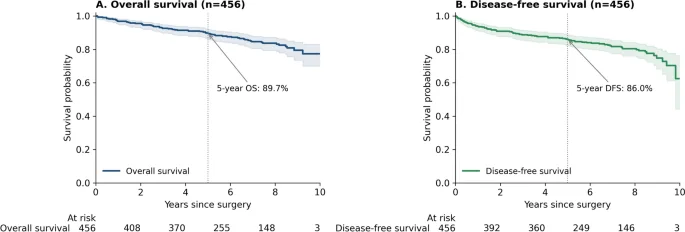
De discriminatie was goed met AUC-waarden tussen 0,79 en 0,85 voor de 3- en 5-jaar recidiefvrije overleving in de trainings- en validatiecohorten. Clinici kunnen het model gebruiken om het recidiefrisico te stratificeren en follow-up intensiteit of adjuvante behandelingen te individualiseren.
Abstract (original)
BACKGROUND: Postoperative recurrence is a primary risk following breast cancer surgery. Compared to older patients, younger breast cancer patients typically experience a poorer prognosis. This study aimed to develop a predictive model based on preoperative serological markers-carbohydrate antigen 125 (CA125) and carbohydrate antigen 153 (CA153) and postoperative treatment modalities to evaluate the 3- and 5-year recurrence-free survival (RFS) in young breast cancer patients aged under 40 years. METHODS: This retrospective study enrolled 521 patients who underwent breast cancer surgery at Fengxian District Central Hospital between June 2015 and April 2020. Based on the inclusion and exclusion criteria, 411 patients aged under 40 were ultimately included and divided into a training cohort and a validation cohort. Clinical characteristics were evaluated, including age, surgical procedure, tumor histological type, history of radiotherapy and chemotherapy, lymphovascular invasion (LVI), neural invasion (NI), tumor-node-metastasis (TNM) stage, molecular subtype, and preoperative serum tumor markers such as CA125 and CA153. Univariate analysis and Cox proportional hazards regression were used to select variables and develop a nomogram based on the training cohort. Survival analysis and plotting were performed using Kaplan-Meier curves and the log-rank test. The reliability of the nomogram was assessed using the concordance index (C-index), calibration plots, and clinical decision curve analysis (DCA). RESULTS: Using the random grouping function in SPSS, the patients were divided into a training cohort (282/411) and a validation cohort (129/411) at a 7:3 ratio. The nomogram prediction model incorporated four risk factors: high expression of CA125 or CA153, receipt of radiotherapy, and LVI. In the training and validation cohorts, the area under the curve (AUC) of the nomogram for predicting 3-year RFS was 0.854 and 0.793, respectively, while the AUC for 5-year RFS was 0.85 and 0.801, respectively. Calibration curves demonstrated that the predicted probabilities of the model were in good agreement with the actual observations. Furthermore, DCA indicated that the nomogram model provided a superior net clinical benefit within the threshold probability range of 10-75%. CONCLUSIONS: We developed a survival prognostic model for young breast cancer patients based on preoperative serum tumor markers and postoperative treatment. The results confirmed that the combination of CA125 and CA153 is of great significance in predicting RFS in young women with breast cancer.
Dit artikel is een samenvatting van een publicatie in Gland surgery. Voor het volledige artikel, alle details en referenties verwijzen wij u naar de oorspronkelijke bron.
Lees het volledige artikelDOI: 10.21037/gs-2026-1-0017