Neoadjuvante chemoimmunotherapie verbetert overleving bij resectabel NSCLC, biomarkers richten verdere zorg
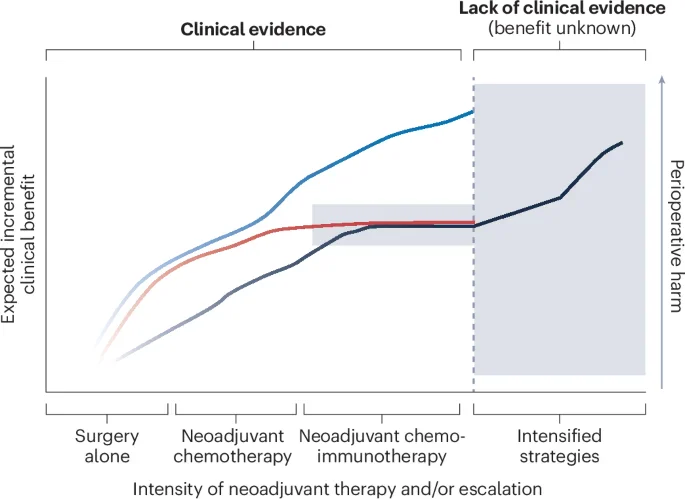
Neoadjuvante chemoimmunotherapie met een anti-PD-(L)1-antistof en platinadubbelfasechemotherapie is de nieuwe standaard van zorg voor patiënten met vroegstadia resectabel niet-kleincellig longkanker (NSCLC) zonder oncogeen-aangedreven mutaties.
Deze aanpak levert aanzienlijk hogere pathologische responspercentages en verbeterde langetermijnoverleving op, maar wordt momenteel uniform toegepast ondanks biologische tumormoeilijkheid. De review benadrukt dat pathologische complete respons (pCR) een robuuste surrogaat is voor duurzaam voordeel en beschrijft hoe complementaire tools zoals circulerend tumor-DNA, radiomics en moleculaire biomarkers kunnen worden ingezet om patiënten te selecteren voor escalatie of de-escalatie van de behandeling.
Deze inzichten stellen oncologen en thoraxchirurgen in staat om de perioperatieve strategie dynamisch aan te passen, waardoor overbehandeling wordt voorkomen en hoge-risicopatiënten gerichter intensiever worden behandeld.
Abstract (original)
Neoadjuvant chemoimmunotherapy, comprising an anti-PD-(L)1 antibody and platinum-doublet chemotherapy, given alone or as part of a perioperative regimen with the addition of adjuvant anti-PD-(L)1 therapy, has become the standard of care for patients with early-stage, resectable non-oncogene-driven non-small-cell lung cancer (NSCLC). This approach has demonstrated substantial increases in pathological response rates and improvements in long-term outcomes, including overall survival. However, these advances have largely been achieved through uniform treatment application across biologically heterogeneous tumours. As a result, a central challenge in contemporary perioperative management is how to identify which patients require escalation or de-escalation of treatment following surgery and which individuals could safely avoid unnecessary treatment. In this Review, we summarize current evidence supporting pathological response, and particularly pathological complete response (pCR), as a robust and clinically meaningful surrogate for durable benefit in patients with NSCLC. We then consider how complementary tools, including circulating tumour DNA, radiomics and metabolic imaging approaches, and baseline molecular and immune biomarkers, can be integrated to refine patient selection and dynamically adapt perioperative strategies. Finally, we describe potential therapeutic strategies to intensify perioperative treatment in biologically high-risk populations, with the dual objective of increasing the likelihood of a pCR and improving disease control in patients with an insufficient pathological response.
Dit artikel is een samenvatting van een publicatie in Nature reviews. Clinical oncology. Voor het volledige artikel, alle details en referenties verwijzen wij u naar de oorspronkelijke bron.
Lees het volledige artikelDOI: 10.1038/s41571-026-01174-7