Minimale invasieve tepel- en areolasparende mastectomie vermindert postoperatieve complicaties bij borstkanker, meta-analyse
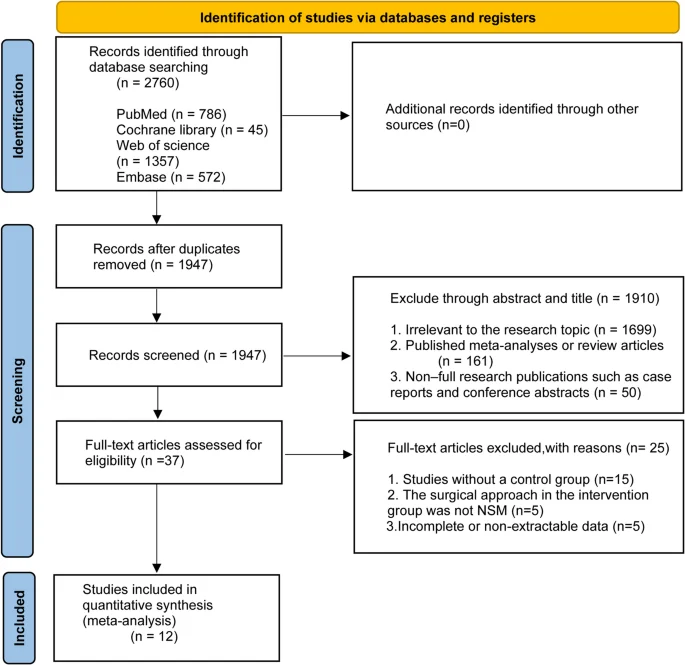
Een meta-analyse van twaalf studies vergeleek minimaal invasieve (robot- of endoscopie-gestuurde) tepel- en areolasparende mastectomie met de conventionele open techniek bij patiënten met borstkanker. De minimaal invasieve aanpak resulteerde in minder bloedverlies, kortere incisie- en reconstructietijden, en lagere frequenties van algemene complicaties, huidnecrose, seroom en hematoom.
Operatietijden waren wel langer, terwijl recidiefvrijheid en specifieke tepelcomplicaties niet significant verschilden. Voor de klinische praktijk biedt deze techniek potentiële voordelen qua minder invasiviteit en postoperatief herstel, maar de beperkte langetermijn-oncologische gegevens en ontbrekende validatie van esthetische uitkomsten vragen om zorgvuldige patiëntselectie en verdere onderzoek.
Abstract (original)
To compare perioperative outcomes, postoperative complications, aesthetic-related outcomes, and oncologic outcomes between minimally invasive nipple-sparing mastectomy (NSM), including robotic-assisted and endoscopic-assisted approaches, and conventional open NSM in patients with breast cancer. Studies comparing minimally invasive and open nipple-sparing mastectomy were searched in PubMed, Embase, Web of Science, and the Cochrane Library. Data on operative outcomes, complications, cosmetic-related indicators, and recurrence were extracted and pooled. Twelve studies were analyzed. Minimally invasive surgery required a longer operative time but was associated with less blood loss, shorter incisions, and shorter reconstruction time. It also showed lower rates of overall complications, skin necrosis, seroma, and hematoma or bleeding. Delayed wound healing, nipple-areola complex complications, nipple necrosis, flap necrosis, and recurrence did not differ significantly between the two groups. Minimally invasive NSM may offer advantages in selected perioperative outcomes, including reduced surgical trauma and postoperative complications. However, evidence regarding long-term oncologic outcomes, recurrence, and patient-reported aesthetic benefits remains limited and requires further validation.
Dit artikel is een samenvatting van een publicatie in Journal of robotic surgery. Voor het volledige artikel, alle details en referenties verwijzen wij u naar de oorspronkelijke bron.
Lees het volledige artikelDOI: 10.1007/s11701-026-03945-x