Matig hypofractioneerde regionale klierbestraling bij borstkanker toont lage lymfoedeemincidentie en uitstekende ziektecontrole
Een prospectieve single-centre studie onderzocht de incidentie van bovenarmlymfoedeem na matig hypofractioneerde regionale klierbestraling (42,56 Gy in 16 fracties) bij 52 vrouwen met niet-metastatisch, lymfklierpositief of hoog-risico lymfkliernegatief invasief borstkanker.
Na 36 maanden trad bij 6,4% van de patiënten klinisch significante lymfoedeem op, zonder significant verschil tussen patiënten met een sentinelle lymfeklierbiopsie versus axillaire lymfeklierdissectie. Uitgebreide meetmethoden verbeterden de detectie niet ten opzichte van standaard tweepuntsmetingen, en er traden geen late toxiciteiten van graad ≥3 op.
De bevindingen ondersteunen de veiligheid en routinematige toepassing van dit bestralingsregime, met weinig bijwerkingen en uitstekende locoregionale controle.
Abstract (original)
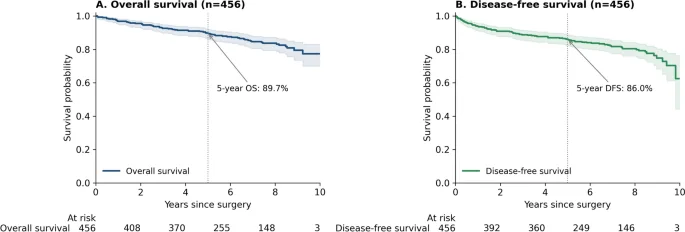
PURPOSE: We conducted a prospective study to evaluate the incidence of upper extremity lymphedema following moderately hypofractionated regional nodal irradiation (MH-RNI) for breast cancer. We incorporated both standardized and expanded arm measurements to determine whether more granular assessment improves lymphedema detection. METHODS AND MATERIALS: This prospective, single-institution trial enrolled women with non-metastatic, lymph node-positive or high-risk node-negative invasive breast cancer following lumpectomy or mastectomy with an indication for RNI. Patients were stratified based on extent of axillary surgery: SLNB (≤5 nodes removed) versus ALND (>5 nodes removed). All patients received 42.56 Gy in 16 fractions to the breast/chest wall and regional lymphatics. The primary endpoint was cumulative incidence of clinically significant upper extremity lymphedema at 3 years. Lymphedema was assessed prospectively, using standard, 2-point circumferential measurements and additional exploratory circumferential measurements obtained at 10-cm intervals along the upper extremity. Competing-risk methods were used for lymphedema analysis, and Kaplan-Meier methods were used for time-to-event outcomes. RESULTS: Fifty-two patients were included; forty-one (78.8%) underwent SLNB, and eleven (21.2%) underwent ALND with a median (IQR) of 3 (2-4) and 10 (8.5-11.5) nodes removed, respectively. The cumulative incidence of lymphedema for all patients was 6.4% at 36 months; 5.7% following SLNB versus 9.1% following ALND (Gray's test p=0.62) with no additional events through 60 months. Additional 10-cm interval measurements did not detect lymphedema earlier than standard measurements or identify any additional cases. Acute and late side effects were predominantly grade 1-2, with no grade ≥3 late adverse events. No locoregional recurrences occurred. DMFS and PFS were 93.4% at 36 months and 87.9% at 60 months. OS was 97.2% at 36 and 60 months. CONCLUSIONS: MH-RNI was associated with a low incidence of upper extremity lymphedema, minor toxicity, and excellent intermediate-term disease control. Extended circumferential measurements did not improve detection of clinically significant lymphedema, supporting the adequacy of standard, two-point measurement techniques for clinical practice and future trials.
Dit artikel is een samenvatting van een publicatie in Practical radiation oncology. Voor het volledige artikel, alle details en referenties verwijzen wij u naar de oorspronkelijke bron.
Lees het volledige artikelDOI: 10.1016/j.prro.2026.08.008