Kleine node-negatieve TNBC vertoont vergelijkbare uitkomsten ondanks verschillende behandelstrategieën
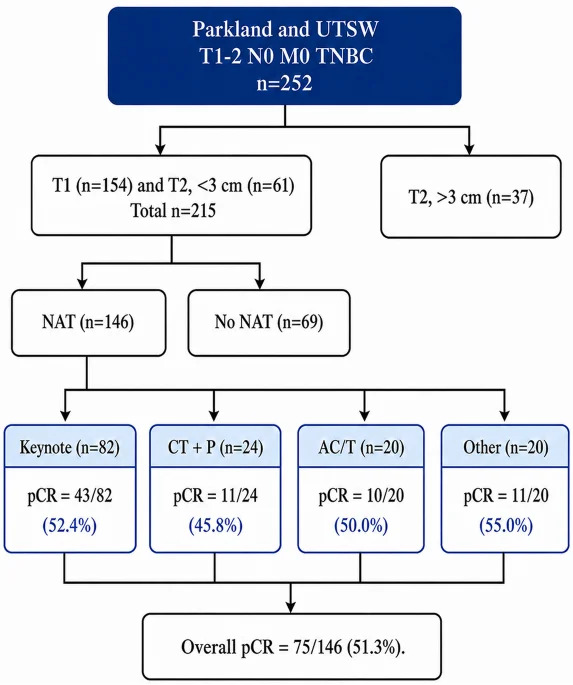
Een retrospectieve multicentrale cohortstudie (n=215) vergeleek de behandelpatronen en uitkomsten van patiënten met kleine, node-negatieve triple-negatieve borstkanker (TNBC) in stadium I versus stadium II (T<3 cm).
Ondanks dat patiënten met stadium II vaker neoadjuvante chemotherapie en adjuvante pembrolizumab ontvingen, waren de recidief- en mortaliteitscijfers evenals de pCR-rates (ongeveer 51%) en eventfree survival identiek tussen beide groepen.
De bevindingen suggereren dat huidige stadiumgebaseerde behandelrichtlijnen mogelijk niet volledig aansluiten bij de klinische biologie van kleine TNBC. Klinici kunnen deze resultaten gebruiken om te reflecteren op de noodzaak van risicoadaptieve, prospectieve studies om neoadjuvante therapie bij deze onderzochte populatie beter te individualiseren.
Abstract (original)
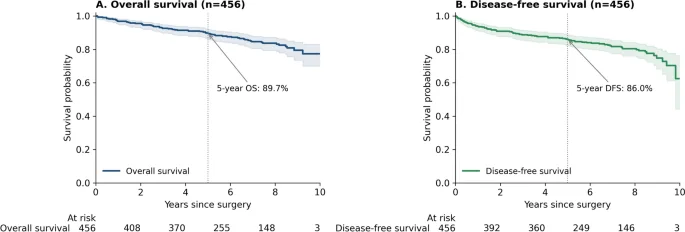
INTRODUCTION: Multi-agent neoadjuvant therapy (NAT) with immune checkpoint blockade is standard treatment for Stage II-III triple-negative breast cancer (TNBC), though its role in smaller node-negative tumors remains unclear. METHODS: We performed a retrospective multi-institutional cohort study evaluating demographics, treatment patterns, and outcomes in a contemporary "small TNBC" population (n = 215) comprising Stage I (n = 154) and Stage II, T < 3 cm TNBC (n = 61). RESULTS: Within the small TNBC cohort, Stage II, < 3 cm tumors demonstrated higher rates of grade 3 histology (93.4% vs 74.7%, p = 0.0013), NAT (85.2% vs 61.0%, p = 0.0006), adjuvant pembrolizumab (56.8% vs 24.7%, adjusted p = 0.0024), and neoadjuvant KEYNOTE-522 (75.0% vs 45.7%, adjusted p = 0.0052) compared with Stage I disease. Despite these treatment differences, recurrence and mortality rates were similar between groups. Among NAT-treated patients with small TNBC (n = 146), the pathologic complete response (pCR) rate was 51.3% (75/146), without significant difference between Stage I and Stage II, < 3 cm tumors (51.1% vs 51.9%, p = 0.92). There were no significant differences in regimen-specific pCR rates or event-free survival (EFS) when comparing NAT between Stage I and Stage II, < 3 cm tumors, or comparing NAT vs. no NAT for the small TNBC cohort. CONCLUSIONS: Stage I and Stage II, < 3 cm TNBC demonstrated overlapping clinicopathologic features, pCR rates, and short-term survival outcomes despite substantially different treatment approaches. These findings suggest that current stage-based treatment distinctions may not fully capture the clinical behavior of small TNBC and support further prospective evaluation of risk-adapted and size-based treatment frameworks to better individualize NAT selection in this understudied population.
Dit artikel is een samenvatting van een publicatie in Breast cancer research and treatment. Voor het volledige artikel, alle details en referenties verwijzen wij u naar de oorspronkelijke bron.
Lees het volledige artikelDOI: 10.1007/s10549-026-08074-5