Integrale review belicht moleculaire evolutie en nieuwe therapieën bij niercelcarcinoom
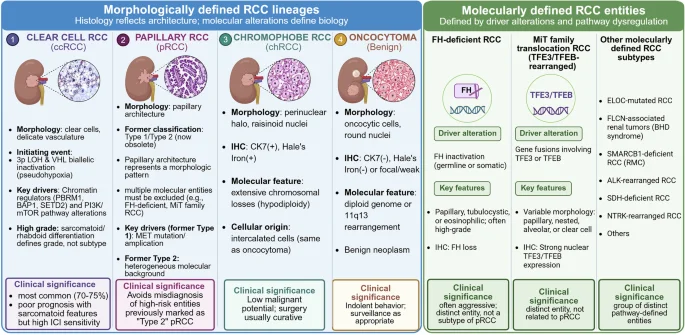
Deze narratieve review vat de recente moleculaire en klinische vooruitgang bij niercelcarcinoom (RCC) samen, waarbij de nadruk ligt op de verschuiving naar moleculaire classificatie volgens de WHO 2022.
Aan de hand van multi-omicsdata en cohorten zoals TRACERx Renal wordt inzichtelijk hoe intratumorale heterogeniteit, klonale selectie en metabole herschikking (zoals de AMPK-mTORC1-as) ziekteprogressie en resistentie bepalen.
De auteurs koppelen deze inzichten aan de evolutie van systemische behandelingen, van VEGF-gerichte tyrosinekinaseremmers en immuuncheckpointcombinaties tot opkomende strategieën zoals HIF-2α-remming en bispecifieke antilichamen.
Voor de klinische praktijk biedt dit overzicht een gestructureerd kader voor biomarker-gestuurde precisie-oncologie en helpt het bij het begrijpen van subtype-specifieke kwetsbaarheden en differentiatieplasticiteit.
Abstract (original)
Renal cell carcinoma (RCC) is a highly heterogeneous malignancy characterized by diverse molecular alterations and dynamic evolutionary trajectories. Advances in genomics and molecular profiling have shifted RCC management from morphology-based classification toward molecularly informed diagnosis and therapy. In this review, we integrate recent multi-omics and clinical advances to define the evolving biological and therapeutic landscape of RCC. We highlight how the 2022 WHO classification incorporates molecular features to refine pathological subtyping and summarize key driver genetic alterations underlying major RCC entities. We then discuss insights derived from multi-region sequencing studies, including TRACERx Renal, which demonstrate how intratumoral heterogeneity, branched evolution, and clonal selection shape disease progression and therapeutic resistance. We further examine subtype-specific metabolic programs, with particular emphasis on dysregulation of the AMPK-mTORC1 signaling axis and distinct metabolic dependencies across clear cell and non-clear-cell RCC. We additionally highlight cell death regulation and differentiation plasticity as integrative themes that connect molecular pathogenesis to therapeutic vulnerability, with sarcomatoid and rhabdoid dedifferentiation as a key example. Finally, we review the evolution of systemic therapies, from VEGF-targeted tyrosine kinase inhibitors to immune checkpoint-based combinations, and outline emerging strategies, including HIF-2α inhibition, PD-1/VEGF bispecific antibodies, and subtype-specific metabolic and epigenetic dependencies. Collectively, this review provides an integrated framework linking molecular evolution, metabolic reprogramming, and therapeutic development, with the goal of advancing biomarker-driven precision management in RCC.
Dit artikel is een samenvatting van een publicatie in Cell death and differentiation. Voor het volledige artikel, alle details en referenties verwijzen wij u naar de oorspronkelijke bron.
Lees het volledige artikelDOI: 10.1038/s41418-026-01857-9