Germline BRCA1/2-mutatie hoger pCR bij triple-negatief borstkanker, maar geen overlevingsvoordeel aangetoond
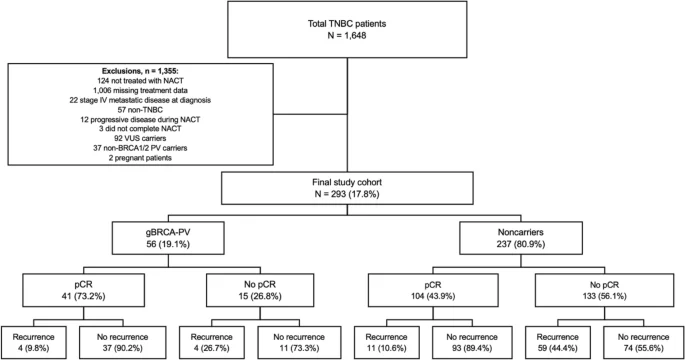
Een retrospectieve single-center cohortstudie onderzocht de associatie tussen germinale BRCA1/2-mutaties en pathologisch complete respons (pCR), recidiefvrije overleving (RFS) en borstkankerspecifieke overleving (BCSS) bij 293 patiënten met stage I-III triple-negatief borstkarcinoom die neoadjuvante chemotherapie ontvingen.
Dragers van een pathogene variant bereikten vaker een pCR dan niet-dragers (73,2% versus 43,9%; p<0,001), maar na correctie voor confounders bleef het verschil in RFS en BCSS statistisch niet significant met onnauwkeurige schattingen.
Hoewel BRCA-dragers beter reageren op neoadjuvante chemotherapie, rechtvaardigt dit op basis van deze beperkte dataset nog geen aanpassing van de behandelstrategie of prognosebegeleiding; grotere cohorts met langere follow-up zijn nodig om de impact op langetermijnoverleving te bevestigen.
Abstract (original)
BACKGROUND: Germline BRCA1/2 pathogenic variants (gBRCA-PV) are associated with chemosensitivity in triple-negative breast cancer (TNBC), but whether higher pathologic complete response (pCR) rates translate into improved long-term outcomes remains uncertain. We assessed associations of gBRCA-PV status with pCR, recurrence-free survival (RFS) and breast cancer-specific survival (BCSS) in a real-world TNBC cohort treated with neoadjuvant chemotherapy (NACT). METHODS: We retrospectively analyzed 293 patients with stage I-III TNBC diagnosed between 2007 and 2023 who were treated with NACT and underwent germline BRCA1/2 testing at a single tertiary center. Multivariable logistic and Cox regression models assessed pCR, RFS and BCSS. RESULTS: Of 293 patients, 56 (19.1%) carried gBRCA-PV. The overall pCR rate was 49.5% and was higher in carriers than noncarriers (73.2% vs. 43.9%, p<0.001). After adjustment for age at diagnosis, clinical stage, NACT regimen, noncarriers had lower odds of pCR (OR 0.36, 95% CI 0.18-0.70, p=0.004). In Cox models, associations between gBRCA-PV status and RFS or BCSS did not reach statistical significance, either with or without adjustment for pCR, and estimates were imprecise. pCR was strongly associated with improved RFS (HR 0.24) and BCSS (HR 0.20) (both p<0.001). CONCLUSIONS: gBRCA-PV carriers were more likely to achieve pCR after NACT, whereas associations with RFS or BCSS remained uncertain. The limited number of events and wide confidence intervals preclude firm conclusions regarding survival differences. Larger cohorts with longer follow-up are needed to clarify the relationship between gBRCA status, treatment response and long-term outcomes.
Dit artikel is een samenvatting van een publicatie in Breast cancer (Tokyo, Japan). Voor het volledige artikel, alle details en referenties verwijzen wij u naar de oorspronkelijke bron.
Lees het volledige artikelDOI: 10.1007/s12282-026-01914-8