Eribulin bevestigt klinische effectiviteit bij HER2-negatief gevorderd borstkanker, DETECT-IVb fase II trial
In de single-arm fase II DETECT-IVb trial onderzochten onderzoekers de effectiviteit en veiligheid van eribulin bij patiënten met HER2-negatief gevorderd borstkanker, met een focus op de dynamiek van circulerende tumorcellen (CTC's).
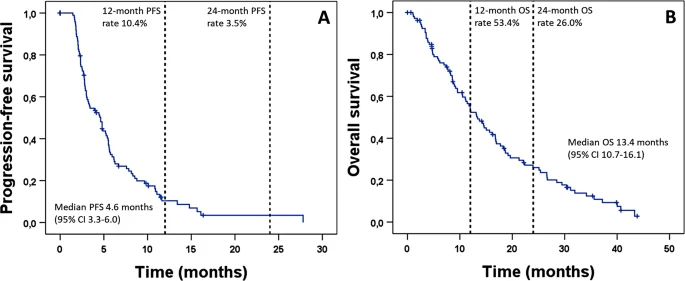
De mediane progressievrije overleving bedroeg 4,6 maanden en de totale overleving 13,4 maanden. Patiënten die CTC's kwijtraakten bij de eerste follow-up (34,7%) of aan het einde van de behandeling (23,1%) hadden significant langer progressievrij leven (p = 0,043 en p = 0,015), zonder significant verschil in totale overleving.
De resultaten bevestigen eribulin als een effectieve behandeloptie in deze risicogroep en ondersteunen de potentiële toevoeging van CTC-dynamiek als vroege biomarker voor behandelrespons in de klinische praktijk.
Abstract (original)
BACKGROUND: Eribulin is a non-taxane microtubule inhibitor that showed survival benefits for pretreated metastatic breast cancer (MBC) patients. Circulating tumor cells (CTCs) are a prognostic marker, but their role in predicting response to specific MBC treatments is less clear. In this trial, we assessed the clinical outcome and its association with CTC-dynamics in HER2-negative MBC treated with eribulin. PATIENTS AND METHODS: HER2-negative MBC-patients were screened for CTCs within the DETECT study program using the CellSearch® technology (Menarini Silicon Biosystems; Bologna, Italy). Patients with HER2-negative CTCs were eligible for the single-arm DETECT-IVb study treatment with eribulin. Primary endpoint was progression-free survival (PFS), and secondary endpoints included overall survival (OS), CTC-clearance rate and safety. RESULTS: Median PFS and OS were 4.6 months and 13.4 months, respectively. Multivariable adjusted analyses showed that patients with CTC-clearance at first follow-up (34.7%) had significantly improved PFS (p = 0.043) but not OS (p = 0.192) compared to patients with at least 1 CTC. Likewise, patients with CTC-clearance at the end of the treatment (23.1%) achieved a significantly better PFS (p = 0.015) but not OS (p = 0.218). Neutropenia, leukopenia, anemia and fatigue were the most common adverse events and no new or unexpected safety signals were obtained. CONCLUSION: In this trial, we could confirm eribulin as an effective treatment option in high-risk HER2-negative MBC. CTCs proved their role as a prognostic marker and our results support the potential role of CTC dynamics as an early biomarker of treatment response to eribulin. TRIAL REGISTRATION: EudraCTNo2013-001269-18 http://ClinicalTrials.gov , TRN NCT02035813, Registration date 2014-01-12.
Dit artikel is een samenvatting van een publicatie in Breast cancer research and treatment. Voor het volledige artikel, alle details en referenties verwijzen wij u naar de oorspronkelijke bron.
Lees het volledige artikelDOI: 10.1007/s10549-026-08069-2