Diagnoseleeftijd borstkanker stijgt niet bij laaginkomens en plattelandsbewoners
Een retrospectieve cohortstudie met SEER-gegevens van 696.960 vrouwen met stadium I-III borstkanker (1975-2021) in kaart bracht de veranderingen in diagnoseleeftijd per sociaaleconomische en geografische subgroep.
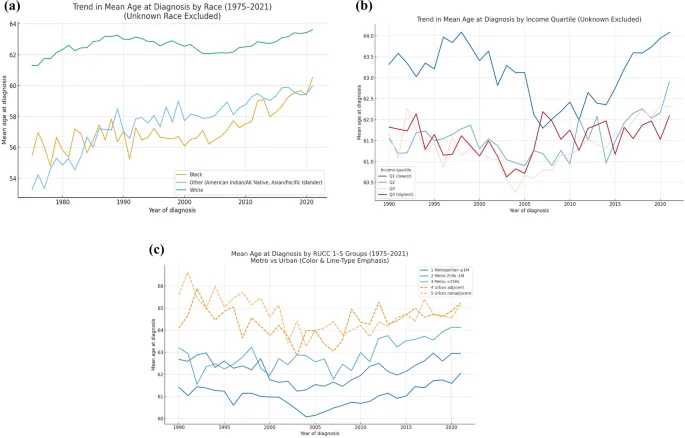
De gemiddelde diagnoseleeftijd steeg landelijk van 60,7 naar 62,7 jaar, maar deze stijging was louter toe te schrijven aan hogere inkomensgroepen en stedelijke gebieden. Bij laaginkomens en plattelandsbewoners bleef de diagnoseleeftijd stagneren of daalde licht, terwijl zwarte vrouwen ondanks de steilste stijgingen het jongst bleven gediagnosticeerd.
Deze sociaaleconomische en geografische kloof vraagt om aangepaste, doelgroepgerichte screeningstrategieën om late diagnoses bij kwetsbare populaties te voorkomen.
Abstract (original)
PURPOSE: While overall breast cancer incidence and survival trends are well-documented, long-term shifts in age at diagnosis across diverse sociodemographic groups remain poorly understood. This study quantified stage-specific temporal changes in diagnostic age across racial, socioeconomic, and geographic subgroups over four decades to identify widening "diagnostic age gaps" and inform equitable screening policies. METHODS: This retrospective cohort study analyzed SEER 8 data (1975-2021) from 696,960 women with Stage I-III breast cancer. Annual mean age at diagnosis and rates of change (β1) were estimated using weighted ordinary least squares regression, stratified by stage, race, census tract-level income quartiles (Q1-Q4), and rural-urban continuum codes. RESULTS: The overall mean age at diagnosis increased from 60.7 to 62.7 years. Black women showed the steepest annual increases in diagnostic age across all stages, yet remained younger at diagnosis than White women throughout the study period. However, a stark divergence was observed by income: high-income groups (Q4) showed significant increases, while low-income groups (Q1) and rural populations exhibited stagnant or declining diagnostic ages (e.g., Q1 Stage II β1= - 0.028). CONCLUSIONS: The upward shift in breast cancer diagnostic age is largely absent among low-income and rural populations but present in higher-income, metropolitan groups. Black women showed the steepest increases yet remained the youngest at diagnosis. Equitable, subgroup-specific screening strategies are needed.
Dit artikel is een samenvatting van een publicatie in Cancer causes & control : CCC. Voor het volledige artikel, alle details en referenties verwijzen wij u naar de oorspronkelijke bron.
Lees het volledige artikelDOI: 10.1007/s10552-026-02247-9