Circulerende miRNA-signatuur onderscheidt invasief ductaal borstkarcinoom van gezonde controlepersonen
Onderzoekers identificeerden een tweevoudige circulerende miRNA-signatuur (miR-6838-5p en miR-195-5p) als potentiële niet-invasieve biomarker voor invasief ductaal borstkarcinoom. In een ontdekkingscohort van 46 behandelnaïeve patiënten en 46 gezonde controles bereikte het gecombineerde model een AUC van 0,923, een resultaat dat zich bevestigde in een onafhankelijke publieke dataset met 1.280 borstkankerpatiënten en 2.684 controles (AUC 0,939).
Deze bevindingen suggereren dat de signatuur een waardevol hulpmiddel kan worden voor de vroege detectie en differentiatie van borstkanker, maar vereist eerst prospectieve validatie in klinisch diverse cohorts en functionele studies om de daadwerkelijke klinische toepasbaarheid te bepalen.
Abstract (original)
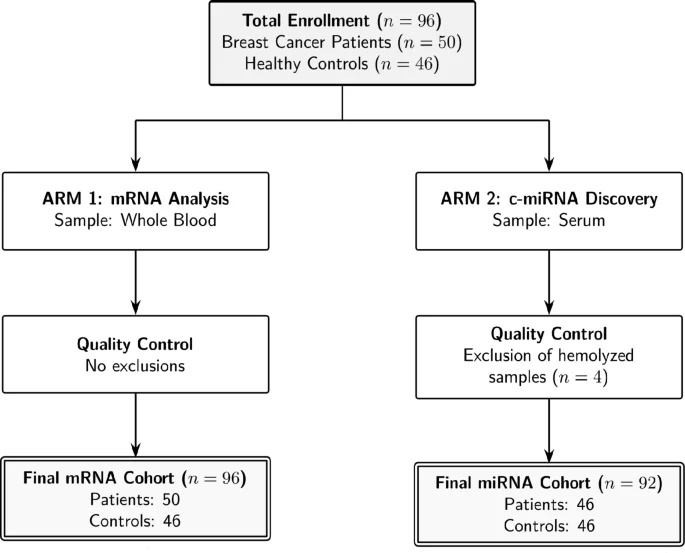
BACKGROUND: Circulating miRNAs (c-miRNAs) are promising non-invasive biomarkers for breast cancer detection, but reproducible signatures remain limited. This study aimed to identify a circulating miRNA signature for invasive ductal breast carcinoma, evaluate its discriminatory performance in an independent serum cohort, and explore the biological context of the selected c-miRNAs. METHODS AND RESULTS: Serum expression of 21 candidate c-miRNAs was analyzed by RT-qPCR in 46 treatment-naive invasive ductal breast carcinoma patients and 46 healthy controls. Whole-blood expression of immune checkpoint-related genes (PDCD1, CD274, CTLA4, and LAG3) was also assessed in 50 patients and 46 controls. Among the 21 candidates, 12 c-miRNAs were significantly dysregulated after FDR correction. miR-6838-5p and miR-195-5p showed the strongest discriminatory performance and were combined into a two-miRNA logistic regression model. This model achieved an AUC of 0.923 (95% CI: 0.873-0.974) in the discovery cohort and an optimism-corrected AUC of 0.917 after 1,000 bootstrap iterations. In the independent GSE73002 serum cohort, including 1,280 breast cancer patients and 2,684 non-cancer controls, the same two-miRNA combination retained strong ROC-derived discriminatory performance with an AUC of 0.939 (95% CI: 0.930-0.948). Exploratory downstream analyses provided additional biological context. CONCLUSIONS: The miR-6838-5p/miR-195-5p combination represents a promising circulating miRNA signature for invasive ductal breast carcinoma. Its consistent discriminatory performance in the discovery cohort and an independent serum cohort supports further evaluation in larger prospective studies. Additional work in clinically diverse cohorts, including benign breast disease and early-stage populations, as well as paired serum-tissue and functional validation studies, is needed to define its clinical applicability and biological origin.
Dit artikel is een samenvatting van een publicatie in Molecular biology reports. Voor het volledige artikel, alle details en referenties verwijzen wij u naar de oorspronkelijke bron.
Lees het volledige artikelDOI: 10.1007/s11033-026-12762-2