Chemotherapie verhoogt p16-expressie in T-cellen zonder verandering in epigenetische verouderingsmarkers bij borstkanker
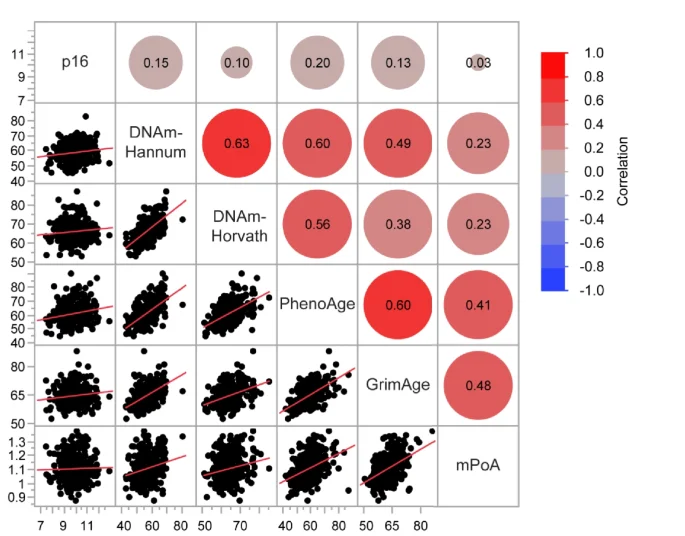
Een cohortonderzoek van 251 vrouwen met vroeg borstkarcinoom en 49 controles onderzocht de relatie tussen p16-expressie in T-cellen en vijf epigenetische klokken vóór en na chemotherapie. De biomarkers vertoonden slechts een zwakke correlatie; patiënten hadden verhoogde waarden voor Hannum, GrimAge en PhenoAge.
Na chemotherapie nam p16 significant toe binnen drie tot zes maanden, terwijl de epigenetische klokken grotendeels stabiel bleven. Dit wijst op verschillende biologische paden van veroudering die verschillend reageren op cytostatica, wat relevant is voor het monitoren van behandelgerelateerde biologische impact.
Abstract (original)
Candidate biomarkers of biologic aging include p16INK4a (p16) expression in peripheral blood T cells, a marker of cellular senescence, and whole-blood DNA methylation (DNAm) clocks, markers of epigenetic aging. Both have been associated with age-accelerating conditions, including cancer and chemotherapy, but their relationship has been inadequately studied. Biomarkers were evaluated in women with early breast cancer (n = 251) and non-cancer controls (n = 49). T-cell p16 expression and five DNAm clocks (Horvath, Hannum, PhenoAge, GrimAge, and Dunedin Pace of Aging [mPoA]) were measured. Baseline associations were assessed using Pearson correlations, and biomarker levels were compared between groups using age-adjusted linear regression models controlling for race, ethnicity, and BMI. In a subset of patients receiving chemotherapy, pre- and post-treatment changes were analyzed. Baseline correlations between p16 and DNAm clocks were weak in both cancer patients and controls (r < 0.3). No significant associations were observed between p16 and Horvath or mPoA clocks. In contrast, Hannum, GrimAge, and PhenoAge were significantly higher in women with breast cancer, and these differences remained after adjustment for covariates. Following chemotherapy, p16 increased significantly within 3-6 months, whereas Horvath, PhenoAge, GrimAge, and mPoA showed no significant change. Hannum age increased modestly (p = 0.02). T-cell p16 and whole-blood DNAm clocks were only weakly correlated and demonstrated different responses to chemotherapy. These findings suggest that cellular senescence and epigenetic clocks reflect distinct aspects of biologic aging and may respond differently to cancer and its treatment.
Dit artikel is een samenvatting van een publicatie in GeroScience. Voor het volledige artikel, alle details en referenties verwijzen wij u naar de oorspronkelijke bron.
Lees het volledige artikelDOI: 10.1007/s11357-026-02521-3