CD19 CAR-T gevolgd door allo-HSCT bij R/R B-ALL: nomogram stratificeert risico op aGVHD en overleving
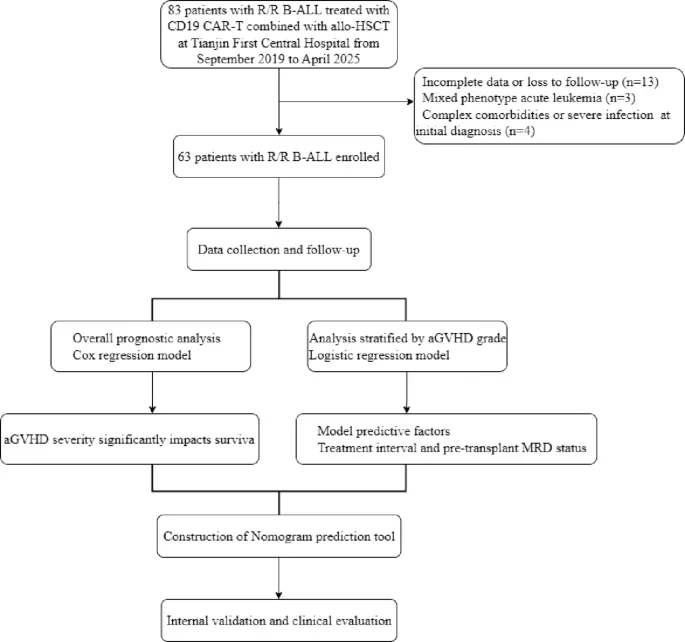
Een retrospectieve analyse van 63 patiënten met recidiverend of refractair B-cel acute lymfoblastaire leukemie (R/R B-ALL) onderzocht de prognostische factoren bij een sequentiële aanpak met CD19 CAR-T-celtherapie gevolgd door allogene hematopoëtische stamceltransplantatie (allo-HSCT).
De tweejarige overleving en progressievrije overleving bedroegen respectievelijk 67,7% en 55,6%. Een langere intervaltijd tussen CAR-T en transplantatie, een positieve MRD-stand voor de transplantatie en hooggradige acute graft-versus-hostziekte (aGVHD) bleken onafhankelijke risicofactoren voor slechtere overleving en ernstige aGVHD.
Het ontwikkelde nomogram (AUC 0,827) biedt een gevalideerd hulpmiddel voor vroege risicostratificatie en gerichte interventies om de uitkomst bij deze complexe patiëntengroep te verbeteren.
Abstract (original)
To evaluate the long-term prognosis of patients with relapsed/refractory B-cell acute lymphoblastic leukemia (R/R B-ALL) who received sequential allogeneic hematopoietic stem cell transplantation (allo-HSCT) following CD19 Chimeric Antigen Receptor T-cell (CAR-T) therapy, and to identify the risk factors influencing overall survival (OS) and the severity of acute graft-versus-host disease (aGVHD). A retrospective analysis was conducted on 63 patients with R/R B-ALL who received sequential allo-HSCT after CD19 CAR-T therapy. Cox regression analysis was used to identify factors influencing OS. Patients were stratified according to the severity of aGVHD (low-grade vs. high-grade). Logistic regression was employed to identify predictors of severe aGVHD, and a nomogram was constructed based on these predictors. The model was internally validated using receiver operating characteristic (ROC) curves, calibration plots, and decision curve analysis (DCA). The two-year OS and progression-free survival (PFS) rates were 67.7% and 55.6%, respectively.The time interval from CAR-T therapy to transplantation, along with high-grade aGVHD, were identified as independent risk factors for OS, whereas low-grade aGVHD exerted a protective effect. A longer time interval from CAR-T therapy to transplantation and pre-transplant minimalresidual disease (MRD)-positive status were independent predictors of severe aGVHD. The nomogram developed for predicting the severity of aGVHD demonstrated good discrimination (areaunder the curve [AUC] = 0.827), satisfactory calibration, and clinical utility upon internal validation. We identified key prognostic factors and developed a validated nomogram that enables early, individualized prediction of severe aGVHD in this setting. This model can assist in early risk stratification and targeted intervention to improve outcomes.
Dit artikel is een samenvatting van een publicatie in Clinical and experimental medicine. Voor het volledige artikel, alle details en referenties verwijzen wij u naar de oorspronkelijke bron.
Lees het volledige artikelDOI: 10.1007/s10238-026-02273-6