Anatomische verdeling van metabole tumorbelaasting op PET/CT voorspelt overleving bij uitzaaiend HER2-positief borstkanker
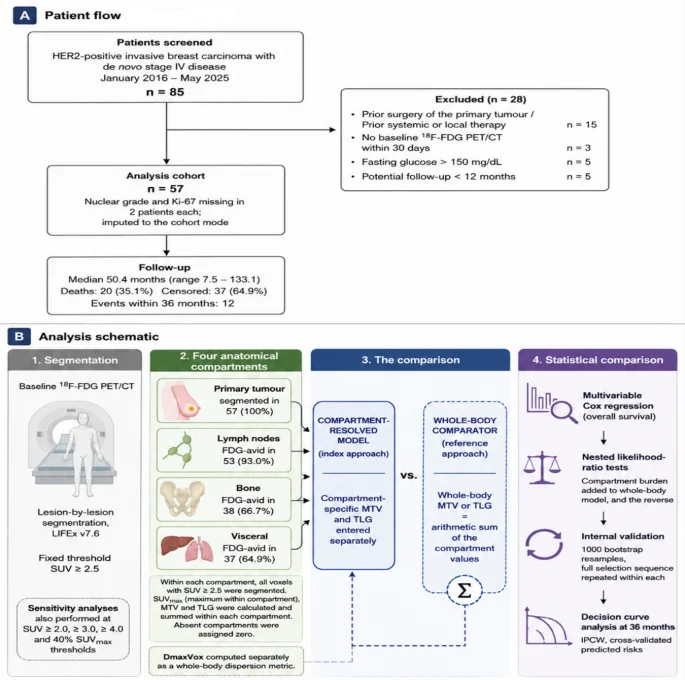
In een retrospectieve analyse van 57 patiënten met nieuw ontstane metastaserend HER2-positief borstkanker werd onderzocht of de anatomische verdeling van metabole tumorbelaasting op ¹⁸F-FDG PET/CT prognostische waarde toevoegt aan conventionele whole-body PET-metrieken.
Multivariabele analyse toonde aan dat compartment-specifieke parameters, zoals lymfeklier-MTV en bot-TLG, onafhankelijk de overleving voorspelden. Het toevoegen van deze verdelingsgegevens verbeterde de voorspellende kracht significant ten opzichte van alleen de totale metabole tumorbelaasting (p=0,003 en p=0,001), terwijl de totale MTV geen extra informatie leverde zodra de verdeling bekend was.
Deze exploratieve bevindingen suggereren dat PET/CT-analyse op basis van anatomische compartimenten mogelijk nuttig is voor risicostratificatie, maar vereisen prospectief multicentrisch onderzoek voordat de methode routinematig in de klinische praktijk kan worden toegepast.
Abstract (original)
OBJECTIVE: Whole-body PET metrics quantify the magnitude of metastatic burden but ignore its anatomical distribution. Whether resolving metabolic burden according to anatomical compartment provides incremental prognostic information beyond conventional whole-body PET metrics remains unknown. We therefore tested whether the anatomical distribution of metabolic burden carries prognostic information beyond aggregate whole-body load in de novo metastatic HER2-positive breast cancer. METHODS: Fifty-seven consecutive treatment-naive patients who underwent baseline ¹⁸F-FDG PET/CT before first-line anti-HER2 therapy were retrospectively analyzed. Compartment-specific metabolic parameters and clinical variables were evaluated using multivariable Cox regression. Model discrimination was internally validated over 1000 bootstrap resamples, and the incremental value of compartment-specific burden over whole-body metrics was evaluated with likelihood-ratio tests. RESULTS: Twenty patients (35.1%) died during a median follow-up of 50.4 months. LN_MTV, Bone_TLG, and HR status independently predicted OS, yielding a model with a modest optimism-corrected C-index of 0.685 when the entire variable-selection sequence was repeated within each bootstrap resample. Adding compartment-specific metabolic burden improved models based on whole-body MTV or TLG (p = 0.003 and p = 0.001, respectively), whereas whole-body MTV provided no additional prognostic information once compartment-specific burden was considered (p = 0.90). Bone_TLG, but not binary bone involvement, independently predicted OS, and its prognostic contribution increased over time. CONCLUSION: In this exploratory analysis, the anatomical distribution of metabolic tumor burden appeared to carry prognostic information beyond conventional whole-body PET metrics. These findings are hypothesis-generating, and prospective multicenter validation is warranted before compartment-specific metabolic phenotyping could inform clinical risk stratification in HER2-positive metastatic breast cancer.
Dit artikel is een samenvatting van een publicatie in Annals of nuclear medicine. Voor het volledige artikel, alle details en referenties verwijzen wij u naar de oorspronkelijke bron.
Lees het volledige artikelDOI: 10.1007/s12149-026-02286-x