Langetermijn cardiale veiligheid van pertuzumab-trastuzumab: TRYPHAENA analyse
Langetermijn cardiale veiligheidsanalyse van neoadjuvant pertuzumab-trastuzumab. Het cardiale profiel was gunstig op lange termijn.
Abstract (original)
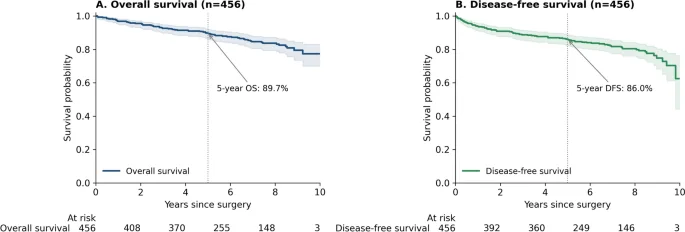
BACKGROUND: We report long-term efficacy and cardiac safety outcomes in patients with HER2-positive early breast cancer treated with neoadjuvant pertuzumab plus trastuzumab with anthracycline-containing or anthracycline-free chemotherapy. METHODS: Descriptive efficacy analyses were conducted in patients randomised to group A (cycles 1-6: trastuzumab [8 mg/kg loading dose and 6 mg/kg maintenance] plus pertuzumab [840 mg loading dose and 420 mg maintenance], plus 5-fluorouracil, epirubicin and cyclophosphamide [FEC] [cycles 1-3; 500 mg/m2 5-fluorouracil/100 mg/m2 epirubicin/600 mg/m2 cyclophosphamide] then docetaxel [cycles 4-6; 75 mg/m2, escalated to 100 mg/m2 if well tolerated]), B (cycles 1-3: FEC, cycles 4-6: trastuzumab plus pertuzumab plus docetaxel as mentioned previously) or C (cycles 1-6: trastuzumab plus pertuzumab plus docetaxel [75 mg/m2, without dose escalation], and carboplatin [AUC 6]), five years after randomisation of the last patient. This study is registered with ClinicalTrials.gov, number NCT00976989. RESULTS: Three-year Kaplan-Meier survival estimates for disease-free survival (DFS) were 87% (95% confidence interval: 79-95), 88% (80-96) and 90% (82-97) in groups A-C, respectively. Progression-free survival (PFS) rates were 89% (81-96), 89% (81-96) and 87% (80-95). DFS hazard ratio for total pathological complete response (tpCR) versus no tpCR was 0.27 (0.11-0.64). During post-treatment follow-up, 2/72 (2.8%), 3/75 (4.0%) and 4/76 (5.4%) patients in groups A-C had any-grade left ventricular systolic dysfunction; eight (11.1%), 12 (16.0%) and nine (11.8%) patients experienced left ventricular ejection fraction declines ≥10% from baseline to <50%. CONCLUSIONS: Long-term DFS and PFS were similar between groups. Patients who achieved tpCR had improved DFS. No new safety signals were identified.
Dit artikel is een samenvatting van een publicatie in European journal of cancer (Oxford, England : 1990). Voor het volledige artikel, alle details en referenties verwijzen wij u naar de oorspronkelijke bron.
Lees het volledige artikelDOI: 10.1016/j.ejca.2017.10.021