Sunvozertinib overtreft chemotherapie als eerste lijn bij NSCLC met EGFR-exon 20-insertiemutaties
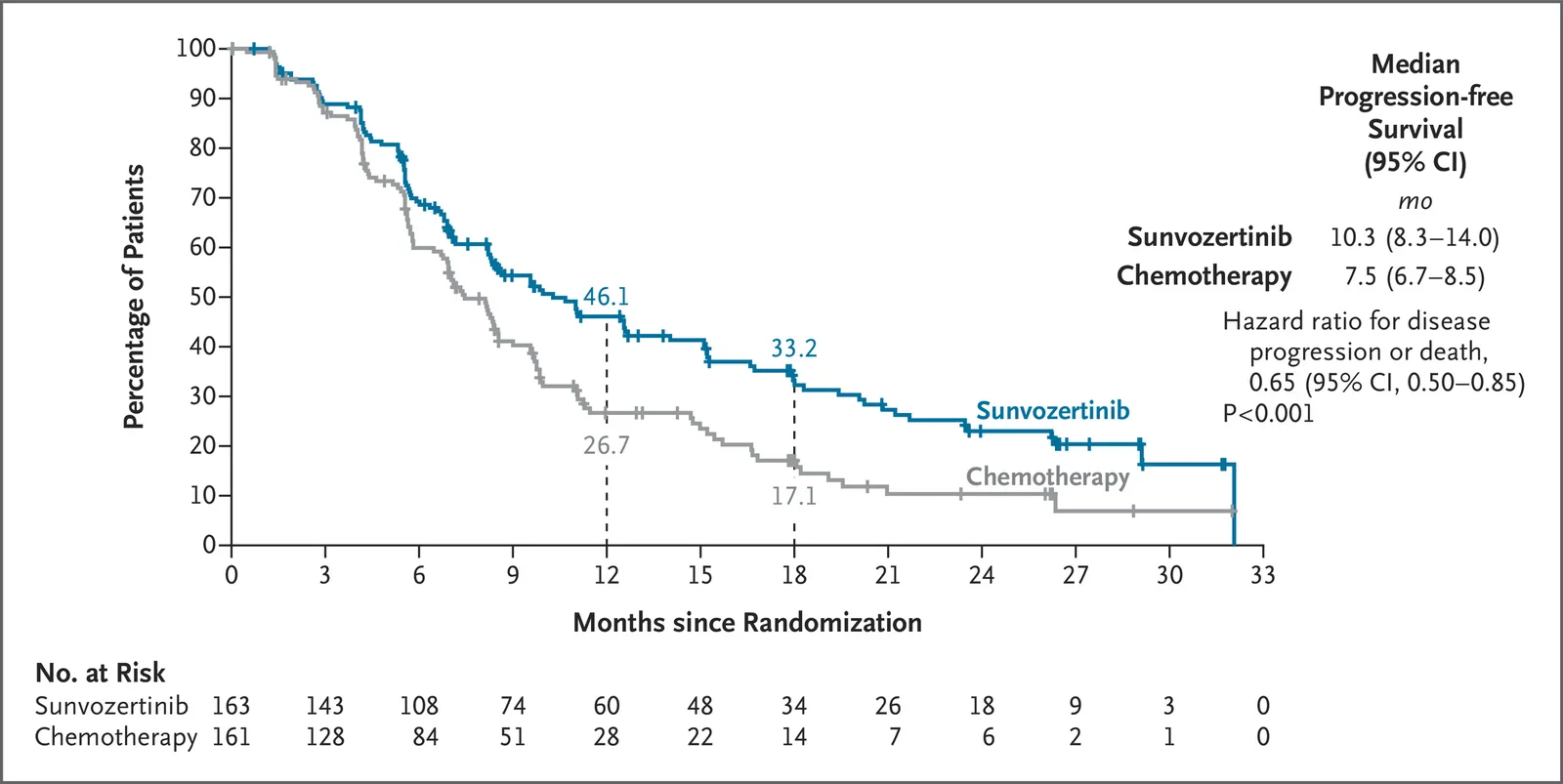
In een fase 3-randomisatietrial kregen patiënten met gevorderd niet-kleencellig longkanker en EGFR-exon 20-insertiemutaties sunvozertinib of carboplatine-pemetrexed als eerste-keus behandeling. Sunvozertinib verlengde de mediane progressievrije overleving significant tot 10,3 versus 7,5 maanden (HR 0,65; P<0,001), met een objectieve respons van 58,9% tegenover 31,1% voor de chemotherapie.
Hoewel de totale overleving nog onrijp is, waren graad 3 of hoger bijwerkingen vaker bij sunvozertinib (75,5% versus 56,7%), zonder gerelateerde sterfgevallen. Deze resultaten maken sunvozertinib tot een nieuwe eerste-keus optie voor deze moleculaire subgroep die voorheen vaak beperkte behandelopties kende.
Abstract (original)
BACKGROUND: Sunvozertinib received accelerated approval for use in later lines of therapy for patients with advanced non-small-cell lung cancer (NSCLC) with epidermal growth factor receptor (EGFR) exon 20 insertion mutations. Data are needed on the efficacy and safety of sunvozertinib as a first-line treatment for NSCLC. METHODS: In this phase 3, international trial, we randomly assigned, in a 1:1 ratio, patients with advanced nonsquamous NSCLC with EGFR exon 20 insertions to receive sunvozertinib or chemotherapy (carboplatin-pemetrexed). The primary end point was progression-free survival as assessed by blinded independent central review. Crossover to the sunvozertinib group was allowed after disease progression was confirmed. Secondary end points included overall survival, investigator-assessed progression-free survival, objective response (complete or partial response), change in tumor size, and duration of response. RESULTS: A total of 324 patients were randomly assigned to receive sunvozertinib (163 patients) or chemotherapy (161 patients). Treatment with sunvozertinib led to significantly longer median progression-free survival than chemotherapy (10.3 vs. 7.5 months; hazard ratio for disease progression or death, 0.65; 95% confidence interval, 0.50 to 0.85; P<0.001). At 12 months, progression-free survival was reported in 46.1% of the patients in the sunvozertinib group and in 26.7% of those in the chemotherapy group; the data for overall survival were immature (38.9% maturity). The percentage of patients with an objective response was 58.9% in the sunvozertinib group and 31.1% in the chemotherapy group; the median best percentage change in tumor size was -42.1% and -24.7% respectively, and the median duration of response was 11.2 and 7.1 months. Grade 3 or higher adverse events were reported in 75.5% of the patients in the sunvozertinib group and in 56.7% of those in the chemotherapy group. In the sunvozertinib group, the most common adverse events of grade 3 or higher included increased serum creatine kinase levels, diarrhea, and anemia. No deaths were attributed to adverse events considered by the investigators to be related to sunvozertinib. CONCLUSIONS: The efficacy of sunvozertinib was superior to that of chemotherapy as first-line treatment for advanced NSCLC with EGFR exon 20 insertions. (Funded by Dizal Pharmaceuticals; WU-KONG28 ClinicalTrials.gov number, NCT05668988.).
Dit artikel is een samenvatting van een publicatie in The New England journal of medicine. Voor het volledige artikel, alle details en referenties verwijzen wij u naar de oorspronkelijke bron.
Lees het volledige artikelDOI: 10.1056/NEJMoa2604461