Spatial fractionated radiotherapy (SFRT) biedt alternatief voor homogene bestraling bij complexe tumoren
Deze review in Nature Reviews Clinical Oncology beschrijft de opkomst van spatial fractionated radiotherapy (SFRT) als alternatief voor traditionele, homogene bestraling bij grote of anatomisch complexe tumoren.
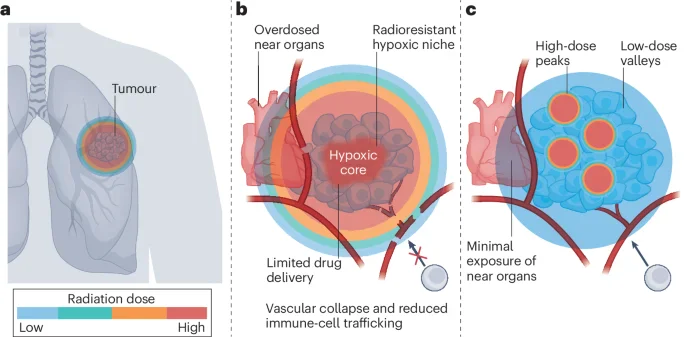
SFRT introduceert opzettelijke dosisvariatie met hoge piekdoses afwisselend met lagere dalen, wat in vroege klinische en preklinische studies gepaard gaat met snelle volumetrische tumorkrimp, aanvaardbare toxiciteit en immunomodulatie van het tumormicromilieu.
De techniek, waaronder GRID, lattice radiotherapie en minibeams, biedt een potentieel veiligere route tot lokale controle wanneer weefseltolerantie homogene dosisescalatie beperkt, hoewel dosimetrie, responscriteria en multicenter reproduceerbaarheid nog verder onderzocht moeten worden.
Abstract (original)
Radiotherapy has traditionally been guided by the principle that uniform delivery of a tumoricidal dose across the entire target volume maximizes local control. However, this paradigm becomes increasingly constrained in the setting of large, bulky or anatomically complex tumours, in which non-malignant tissue tolerances often preclude homogeneous dose escalation. Spatially fractionated radiotherapy (SFRT) has emerged as a complementary approach that introduces intentional intratumoural dose heterogeneity as an alternative therapeutic strategy when uniform irradiation is not feasible. SFRT involves the delivery of radiation as high-dose 'peaks' interspersed with lower-dose 'valleys', creating spatial domains that combine focal tumoricidal exposures with partial preservation of vascular, stromal and immune-related functions within the tumour microenvironment. Preclinical investigations and early clinical studies suggest that such architectures might be associated with rapid volumetric tumour regression, acceptable toxicity profiles and modulation of the tumour immune microenvironment, although the underlying mechanisms, generalizability and durability of these effects remain incompletely defined. In this Review, we summarize the conceptual foundations, biological hypotheses and clinical activity of SFRT, spanning macroscopic approaches such as GRID and lattice radiotherapy, biology-guided strategies and submillimetric implementations using minibeams and microbeams. We also highlight key translational and methodological limitations and discuss various challenges relating to dosimetry, biologically meaningful response assessments, patient selection and multicentre reproducibility.
Dit artikel is een samenvatting van een publicatie in Nature reviews. Clinical oncology. Voor het volledige artikel, alle details en referenties verwijzen wij u naar de oorspronkelijke bron.
Lees het volledige artikelDOI: 10.1038/s41571-026-01161-y