Segmentale en niet-segmentale cavaresectie bij robotgeassisteerde nefrectomie met trombusverwijdering tonen vergelijkbare veiligheids- en nierfunctie-uitkomsten
Een retrospectieve single-center cohortstudie van 120 patiënten met niercelcarcinoom en een IVC-thrombus (Mayo niveau II-IV) vergeleek segmentale met niet-segmentale resectie van de vena cava inferior tijdens robotgeassisteerde nefrectomie.
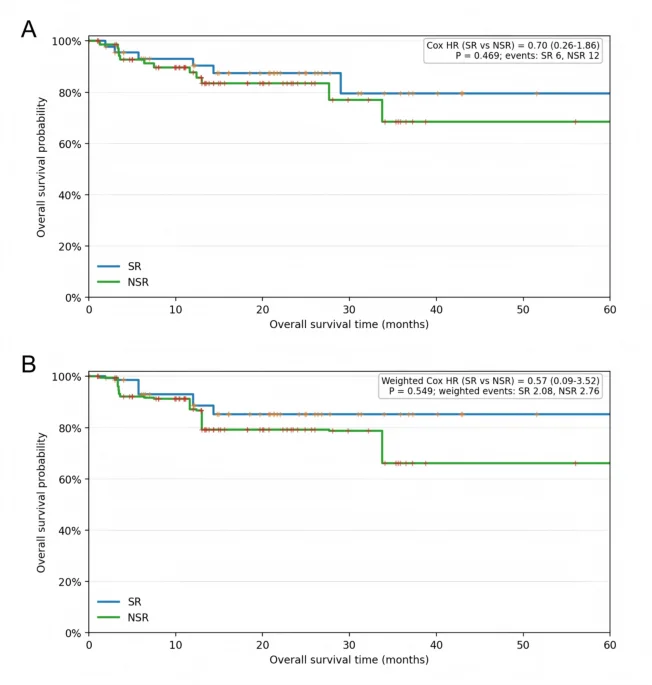
Na overlap-weighting toonden beide technieken geen significant verschil in acute nierfunctiestoornis, verandering in serumcreatinine of eGFR, complicaties, ziekenhuisverblijf of overleving, al werd bij segmentale resectie wel een lager bloedtransfusievolume gemiddeld (-249,63 mL; P = 0,011).
De studie kon echter geen non-inferioriteit of equivalentie voor nierfunctie en ziekenhuisverblijf aantonen. Voor de klinische praktijk betekent dit dat de keuze tussen beide technieken primair afhankelijk blijft van trombuswand-invasie, cavapaterniteit en nierreserve, aangezien er geen eenduidig veiligheids- of functioneel voordeel is.
Abstract (original)
PURPOSE: IVC segmental resection (SR) during robot-assisted radical nephrectomy and IVC thrombectomy (RARN-IVCT) is selected for wall invasion, occlusion, and collateral outflow, making direct comparison with non-segmental resection (NSR) biased. We compared the perioperative and renal safety of SR versus NSR in the overlap population. METHODS: Retrospective single-center cohort at Peking University Third Hospital (2014-2025): 120 patients with RCC and Mayo level II-IV IVC thrombus undergoing RARN-IVCT, including 45 SR and 75 NSR. Overlap weighting balanced baseline variables. Primary outcomes were AKI, ΔSCr, and ΔeGFR; secondary outcomes were complications and hospital stay, with OS assessed exploratorily. RESULTS: After weighting, no statistically significant differences were observed in AKI, ΔSCr, ΔeGFR, complications, hospital stay, or OS. SR had lower RBC transfusion volume (mean difference - 249.63 mL, 95% CI - 443.20 to - 56.05; P = 0.011). SR met non-inferiority/equivalence for hospital stay and pneumonia; renal non-inferiority was not established. Limitations include retrospective design, limited effective sample size, and unmeasured anatomic/hemodynamic confounding. CONCLUSION: In overlap patients, no statistically significant differences in renal or safety/recovery outcomes were observed, but neither renal non-inferiority nor equivalence was established. Planning should consider thrombus-wall interaction, caval patency, collateral outflow, and renal reserve.
Dit artikel is een samenvatting van een publicatie in World journal of urology. Voor het volledige artikel, alle details en referenties verwijzen wij u naar de oorspronkelijke bron.
Lees het volledige artikelDOI: 10.1007/s00345-026-06725-2