Ruimtelijke analyse van tumorimmuunmicro-omgeving voorspelt recidiefvrije overleving bij rectumcarcinoom
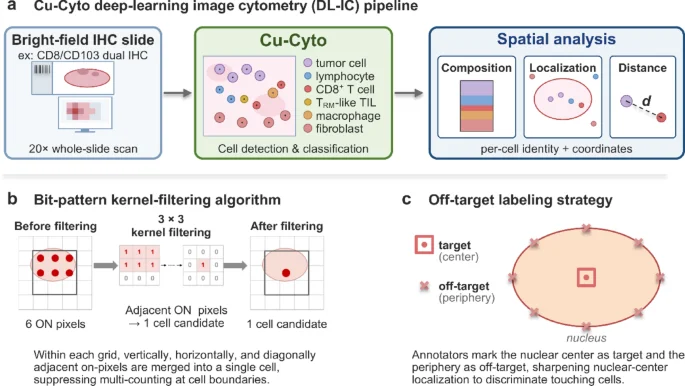
Onderzoekers introduceren een diepleerframework dat ruimtelijke interacties tussen cellen in pathologie-preparaten van rectumcarcinoom kwantificeert. Bij patiënten die neoadjuvant chemoradiotherapie hebben ondergaan, voorspelt de dichtheid van CD103⁺CD8⁺ T-cellen in het stroma, maar niet in de tumor, de recidiefvrije overleving onafhankelijk.
De voorgestelde co-localisatie-index maakt het mogelijk om dergelijke micro-omgevingsdynamiek en tri-celulaire interacties nauwkeurig in kaart te brengen. Deze methode biedt potentieel voor verbeterde stratificatie van patiënten voor organbehoud of adjuvante therapie, maar vereist prospectieve validatie in onafhankelijke cohorts voordat toepassing in de routinediagnostiek verantwoord is.
Abstract (original)
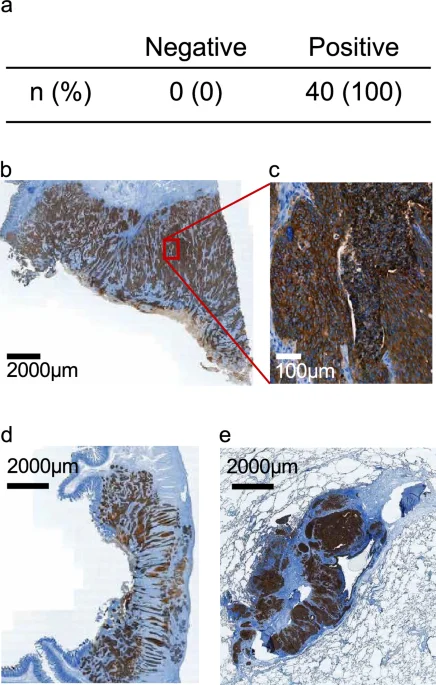
The tumor immune microenvironment in colorectal cancer has emerged as a major determinant of patient outcome, with tumor-infiltrating lymphocytes, particularly CD8⁺ T cells, mediating antitumor immunity. Standardized density-based metrics such as the Immunoscore have demonstrated prognostic value but cannot capture the spatial interactions among cells that underlie immune-tumor biology. We introduce a deep learning framework that integrates two complementary axes of analysis: Cu-Cyto, a deep learning-based image cytometry platform that detects and classifies approximately twenty cell types from standard immunohistochemistry-stained whole-slide images, using a bit-pattern kernel-filtering algorithm to prevent multi-counting and an off-target labeling strategy for precise nuclear-center localization; and the Co-Localization Index, which converts the classification probabilities and coordinates produced by Cu-Cyto into a single quantitative measure of co-localization between two or three cell types. We illustrate this framework through CD103⁺CD8⁺ tissue-resident memory-like T cells in rectal cancer treated with neoadjuvant chemoradiotherapy: their stromal but not intratumoral density independently predicts relapse-free survival. This divergence, which compartment-aware density alone cannot explain, motivates a metric that captures within-compartment spatial relationships. The Co-Localization Index extends naturally to three-cell interactions, providing a quantitative readout of the tri-cellular biology among CD103⁺CD8⁺ T cells, tumor cells, and stromal components. Prospective validation in independent rectal-cancer cohorts, addressing watch-and-wait organ preservation and adjuvant chemotherapy decisions, will determine whether this spatial-cellular framework translates into routine clinical decision support with potential extension to other solid tumor contexts.
Dit artikel is een samenvatting van een publicatie in International journal of clinical oncology. Voor het volledige artikel, alle details en referenties verwijzen wij u naar de oorspronkelijke bron.
Lees het volledige artikelDOI: 10.1007/s10147-026-03182-0