Integratie van immuuntherapie en ctDNA-stratificatie hervormt perioperatieve behandeling van gastro-oesofageaal adenocarcinoom
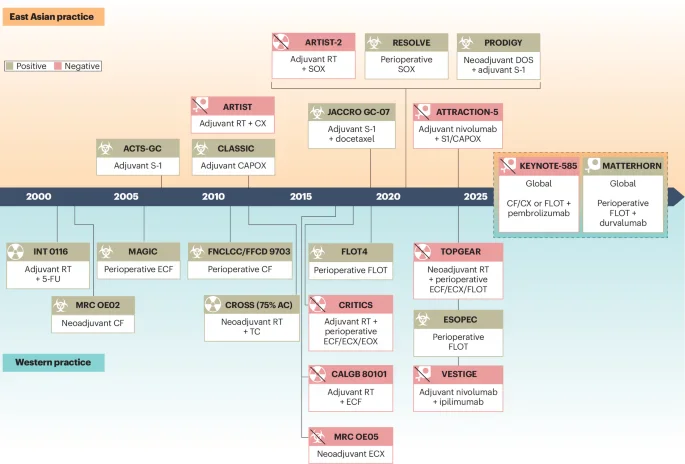
Deze gestructureerde review schetst de recente evolutie in de perioperatieve behandeling van gastro-oesofageaal adenocarcinoom op basis van epidemiologische trends en recente klinische trials. De behandelstrategie verschuift van standaardchemotherapie naar combinatieregimes met immuuncheckpointremmers en targeted therapies, waarbij radiotherapie en chemotherapie hun rol blijven behouden.
Daarnaast worden organbehoudende protocollen en circulating tumour DNA (ctDNA)-gestuurde patiëntstratificatie gepresenteerd als veelbelovende ontwikkelingen. Voor de klinische praktijk biedt dit overzicht een gestructureerd kader voor besluitvorming rond multimodale behandelingen en moleculaire diagnostiek, met directe implicaties voor de selectie van patiënten voor experimentele protocollen.
Abstract (original)
The landscape of gastro-oesophageal adenocarcinoma (GEA) management has undergone substantial transformation over the past decade owing to shifts in epidemiology, evolving treatment paradigms and the integration of new therapeutic strategies. The global burden of GEA continues to rise, with differing patterns observed in Asia compared with Western countries. Important insights gleaned from recent high-profile clinical trials - both successful and negative - have considerably reshaped perioperative treatment strategies, redefining the roles of chemotherapy, radiotherapy, immune checkpoint inhibitors and targeted therapies. Although still investigational, organ-preserving approaches and circulating tumour DNA (ctDNA)-based patient stratification are shaping the direction of future GEA management. By consolidating these developments, this Review aims to provide clinicians and researchers with a comprehensive and structured guide to the state-of-the-art perioperative management of GEA, emphasizing the underlying biology, clinical implications and future directions.
Dit artikel is een samenvatting van een publicatie in Nature reviews. Clinical oncology. Voor het volledige artikel, alle details en referenties verwijzen wij u naar de oorspronkelijke bron.
Lees het volledige artikelDOI: 10.1038/s41571-026-01156-9