Geprogrammeerde bloedplaatjes als dragers voor gerichte kankertherapie
Deze narratieve review in Nature Reviews Clinical Oncology schetst de context-afhankelijke rol van bloedplaatjes in kanker en presenteert opkomende genetische en chemische engineeringsstrategieën om ze als therapeutische dragers in te zetten.
In plaats van traditionele remming of stimulatie, worden geprogrammeerde plaatjes ingezet om cytostatica of immuunmodulerende middelen gericht naar de tumor te transporteren of als effectorcellen te fungeren die de tumormicro-omgeving direct beïnvloeden.
De auteurs wijzen erop dat zowel autologe als allogene toepassing mogelijk is, maar dat klinische implementatie nog afhankelijk blijft van gecontroleerde activatie, schaalbare productiekaders en rigoureuze veiligheidstesten.
Deze benadering biedt een veelbelovend pad voor de ontwikkeling van nieuwe systemische therapieën binnen de precisie-oncologie.
Abstract (original)
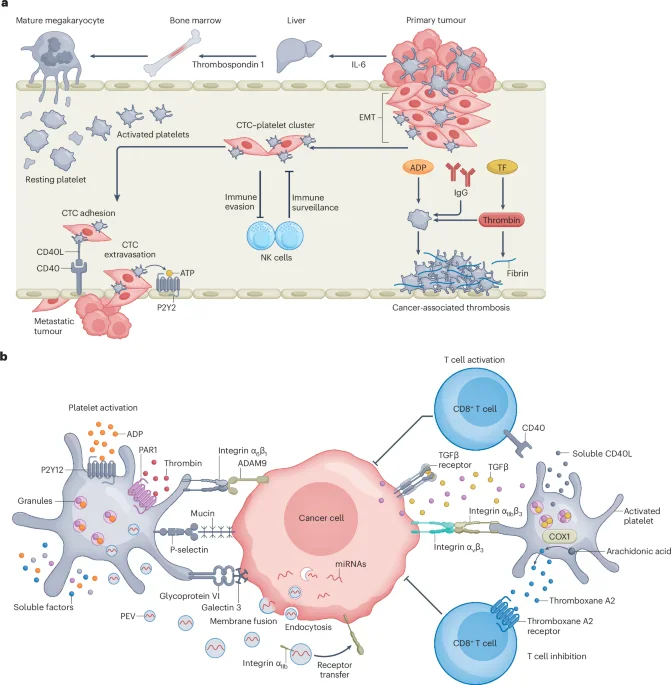
Accumulating evidence indicates that platelets promote cancer progression through direct interactions with malignant cells, the secretion of soluble mediators and the release of platelet-derived extracellular vesicles. In certain contexts, platelets can also suppress tumour progression by modulating immune responses, delivering antiproliferative microRNAs or releasing inhibitory factors. This dynamic and context-dependent interplay limits the effectiveness of strategies that solely inhibit or activate platelet activity and has driven the development of engineering approaches to reprogramme platelets with therapeutic intent. Unlike most cellular products, platelet-based approaches can be implemented in both autologous and allogeneic settings, providing more flexible approaches for developing new therapies. Over the past few years, advances in genetic and chemical engineering have enabled the multifunctional modification of platelets while preserving native properties essential for cancer therapy. Engineered platelets can act as targeted delivery vehicles to enhance local drug accumulation and release, or as active effector cells that directly modulate tumour progression. The clinical implementation of these engineered products will require control of platelet stability and activation, scalable manufacturing processes and rigorous safety evaluation. In this Review, we summarize the current understanding of platelet biology in cancer, examine engineering strategies for their therapeutic use, and outline opportunities and challenges for their clinical translation.
Dit artikel is een samenvatting van een publicatie in Nature reviews. Clinical oncology. Voor het volledige artikel, alle details en referenties verwijzen wij u naar de oorspronkelijke bron.
Lees het volledige artikelDOI: 10.1038/s41571-026-01122-5