Gecombineerd MRI- en klinisch model voorspelt pathologische respons na neoadjuvante therapie bij rectumcarcinoom
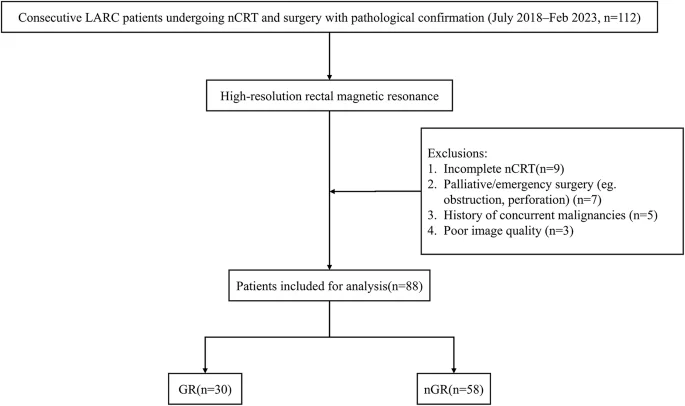
In een retrospectieve studie van 88 patiënten met lokaal gevorderd rectumcarcinoom werd onderzocht of een gecombineerd model op basis van multiparametrische MRI-biomarkers en klinische factoren de pathologische respons op neoadjuvante chemoradiotherapie kan voorspellen.
Multivariaate analyse toonde aan dat geslacht, de MRI-tumorresponsgraad (mrTRG) en de relatieve verandering in ADC-waarden (ΔADC%) onafhankelijke voorspellers waren. Het gecombineerde model bereikte een AUC van 0,958 (gecorrigeerd 0,949), wat aanzienlijk beter scoorde dan individuele parameters.
Deze bevindingen suggereren dat de integratie van standaard MRI-fenotypen en kwantitatieve diffusieparameters nuttig kan zijn voor het stratificeren van patiënten en het ondersteunen van individuele behandelbeslissingen, hoewel externe validatie noodzakelijk is voor klinische implementatie.
Abstract (original)
OBJECTIVE: To evaluate the utility of multiparametric MRI combined with clinical and laboratory biomarkers in predicting pathologic response to neoadjuvant chemoradiotherapy (nCRT) in patients with locally advanced rectal cancer (LARC). METHODS: This retrospective study included 88 LARC patients who received nCRT followed by total mesorectal excision (TME). Based on pathological tumor regression grade (pTRG), patients were categorized into a good response group (GR, pTRG 0-1, n = 30) and a non-good response group (nGR, pTRG 2-3, n = 58). Independent predictors of GR were identified through univariable and multivariable logistic regression analyses. A combined predictive model was developed, and its predictive performance and calibration were evaluated using receiver operating characteristic curve (ROC) analysis and a calibration curve, with internal validation performed using 1000 bootstrap resamples. RESULTS: Compared with the nGR group, the GR group had a higher proportion of female patients, a lower rate of carcinoembryonic antigen positivity, a higher proportion of patients with good magnetic resonance tumor regression grade (mrTRG-good), lower ADCₚᵣₑ, higher ADCₚₒₛₜ, and greater ΔADC% (all p < 0.05). Multivariable analysis identified gender, mrTRG, and ΔADC% as independent predictors of GR. The combined model integrating these three independent predictors achieved an apparent area under the curve (AUC) of 0.958, which was significantly higher than that of any individual predictor (all p < 0.05). Bootstrap validation yielded an optimism-corrected AUC of 0.949, and the model showed good calibration. CONCLUSION: The combined model incorporating gender, mrTRG, and ΔADC% showed promising performance for the prediction of pathologic response after nCRT in patients with LARC and may support individualized treatment decision-making.
Dit artikel is een samenvatting van een publicatie in Abdominal radiology (New York). Voor het volledige artikel, alle details en referenties verwijzen wij u naar de oorspronkelijke bron.
Lees het volledige artikelDOI: 10.1007/s00261-026-05740-6