Post-chemoradiotherapie RANO-classificatie verbetert prognose-inschatting bij IDH-wildtype glioblastoom
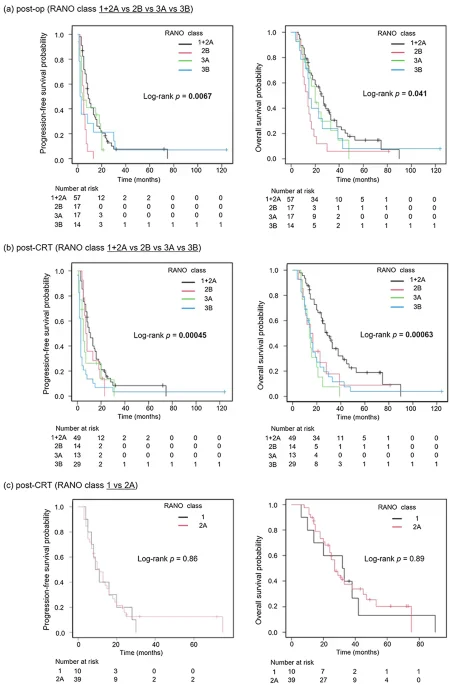
Een retrospectieve cohortstudie van 105 patiënten met IDH-wildtype glioblastoom onderzocht de prognostische waarde van de RANO-ressectieclassificatie na chemoradiotherapie en MRI-volumetrie. De classificatie na chemoradiotherapie stratificeerde de overleving significant beter dan de postoperatieve indeling (p < 0,001 voor zowel progressievrije als totale overleving).
Een volumereductie van T2W/FLAIR-afwijkingen van minimaal 80% na behandeling was onafhankelijk geassocieerd met een verbeterde totale overleving (HR 0,36; p = 0,013). Deze bevindingen suggereren dat herclassificatie na chemoradiotherapie, gecombineerd met volumetrische MRI-analyse, een nuttige aanvulling kan zijn op de standaard postoperatieve beeldvorming voor prognostische stratificatie bij glioblastoom.
Abstract (original)
BACKGROUND: Classification by the Response Assessment in Neuro-Oncology (RANO) resect group has recently been proposed as a prognostic stratification system for glioblastoma (GBM). However, postoperative T2-weighted/FLAIR (T2W/FLAIR) abnormalities may include edema and surgery-related changes, limiting accurate evaluation of non-contrast-enhancing tumor burden. Therefore, we investigated the prognostic utility of post-chemoradiotherapy (post-CRT) RANO resect classification and T2W/FLAIR volumetric changes in GBM. METHODS: We retrospectively analyzed 105 consecutive patients with GBM who underwent surgical resection followed by CRT. MRI-based volumetric analyses were performed, RANO resect classification was applied, and T2W/FLAIR-based parameters were evaluated. RESULTS: Only one patient was classified as postoperative RANO resect Class 1, whereas 10 met Class 1 criteria following CRT. Post-CRT RANO resect classification demonstrated superior prognostic stratification compared with postoperative classification (Classes 1, 2 A, 2B, 3 A, and 3B; progression-free survival: 10, 11, 7.5, 5, and 3 months, respectively; p < 0.001; overall survival [OS]: 32.5, 27, 16, 14, and 15 months, respectively; p < 0.001). Survival outcomes did not differ between Classes 1 and 2 A. Among 49 patients with post-CRT RANO resect Class 1/2A, T2W/FLAIR volume reduction ≥ 80% was independently associated with improved OS (hazard ratio: 0.36, p = 0.013). Patients with either RANO resect Class 1 or ≥ 80% T2W/FLAIR reduction demonstrated significantly improved progression-free survival and OS. Telomerase reverse transcriptase (TERT) promoter wildtype status was independently associated with lower post-CRT T2W/FLAIR volume. CONCLUSIONS: Post-CRT RANO resect classification may provide improved prognostic stratification in GBM. Integration of T2W/FLAIR volume reduction may further refine prognostic assessment within non-contrast-enhancing tumors.
Dit artikel is een samenvatting van een publicatie in Journal of neuro-oncology. Voor het volledige artikel, alle details en referenties verwijzen wij u naar de oorspronkelijke bron.
Lees het volledige artikelDOI: 10.1007/s11060-026-05731-z