Multicenter machine learning model voorspelt lokale controle na stereotactische bestraling bij craniopharyngioom
Een multicenter studie van 277 patiënten met craniopharyngioom onderzocht de nauwkeurigheid van een machine learning-model (Random Survival Forest) om de tijd tot lokale progressie na stereotactische radiosurgery (SRS) te voorspellen.
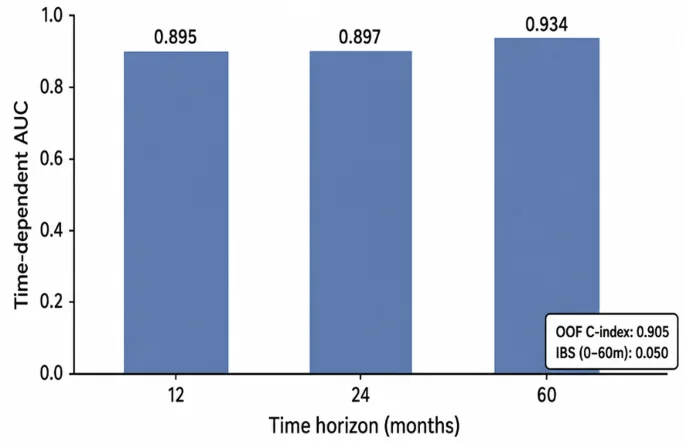
Het model toonde een uitstekende discriminatie met een C-index van 0,905 en tijdafhankelijke AUC-waarden tussen 0,895 en 0,934 over 60 maanden, met goede kalibratie. Deze individuele voorspellingen kunnen neuro-oncologen en radiotherapeuten ondersteunen bij het afstemmen van follow-upfrequenties en het voeren van individuele patiëntgesprekken over de verwachte lokale controle na SRS.
Abstract (original)
BACKGROUND: Stereotactic radiosurgery (SRS) is used in selected patients with craniopharyngioma, yet counseling and follow-up planning often rely on population-level local control rates rather than individualized expectations over time. OBJECTIVE: To develop and internally validate a multicenter survival model to predict imaging-defined time to progression after SRS for craniopharyngioma. METHODS: We analyzed a multicenter IRRF registry of SRS-treated craniopharyngioma patients. Imaging progression was defined by the overall last imaging response (PD vs. non-PD), with censoring at last imaging follow-up when progression was not observed. A Random Survival Forest (RSF) model was evaluated using 5-fold out-of-fold cross-validation. Performance was assessed using the concordance index, time-dependent AUC at 12, 24, and 60 months with bootstrap 95% confidence intervals, integrated Brier score (IBS) over 0-60 months, and risk-stratified calibration. Benchmarks included a penalized Cox model and a Kaplan-Meier baseline. RESULTS: Among 277 patients (event rate 13.0%; median imaging follow-up 57.0 months by reverse Kaplan-Meier), RSF achieved an out-of-fold C-index of 0.905. Time-dependent AUC was 0.895 (95% CI 0.828-0.959) at 12 months, 0.897 (95% CI 0.833-0.952) at 24 months, and 0.934 (95% CI 0.889-0.969) at 60 months. IBS (0-60 months) was 0.050 with favorable calibration. CONCLUSIONS: A multicenter machine learning survival model can provide individualized, well-calibrated estimates of local control over time after SRS for craniopharyngioma to support non-prescriptive decision support. CLINICAL TRIAL NUMBER: Not applicable.
Dit artikel is een samenvatting van een publicatie in Journal of neuro-oncology. Voor het volledige artikel, alle details en referenties verwijzen wij u naar de oorspronkelijke bron.
Lees het volledige artikelDOI: 10.1007/s11060-026-05736-8