Populatie-farmacokinetische analyse bevestigt geen routinematige dosisaanpassing voor savolitinib bij gevorderde solide tumoren
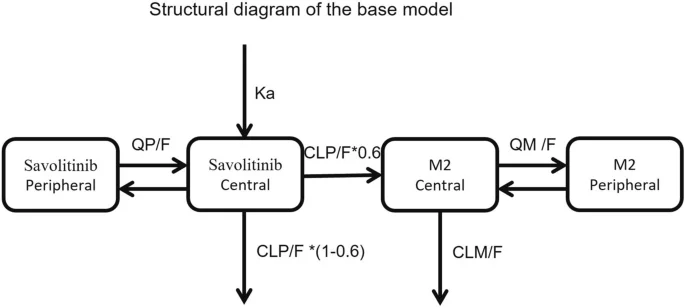
Een gepoolde populatie-farmacokinetische analyse van acht studies karakteriseerde de blootstelling aan savolitinib en metaboliet M2 bij 704 patiënten met gevorderde solide tumoren. Lichaamsgewicht, nierfunctie en leverfunctie bleken statistisch significante covariaten voor de klaring, maar de mate van verandering is modest ten opzichte van de natuurlijke inter-individuele variabiliteit.
Hieruit volgt dat er onvoldoende bewijs is voor routinematige initiële dosisaanpassingen bij patiënten met afwijkende nier- of leverfunctie of extremen van lichaamsgewicht. Deze bevindingen ondersteunen het huidige doseringsregime van savolitinib en bieden oncologen en klinisch farmacologen een onderbouwd uitgangspunt voor het monitoren van de therapie bij METex14-gemuteerd longkanker.
Abstract (original)
BACKGROUND: Savolitinib is a highly selective small-molecule inhibitor of the mesenchymal-epithelial transition (MET) factor tyrosine kinase, which was approved by the National Medical Products Administration (NMPA) of China for patients with MET exon 14 (METex14)-altered locally advanced or metastatic non-small cell lung cancer (NSCLC). However, the pharmacokinetics profiles of savolitinib and its active metabolite M2 have not been comprehensively characterised in an integrated manner across different studies, tumour types and treatment settings. METHODS: A non-linear mixed-effects model was developed to characterise the population pharmacokinetics of savolitinib and its active metabolite M2 in patients with advanced solid tumours. The analysis included 7192 savolitinib concentration observations from 704 participants and 7162 M2 concentration observations from 702 participants pooled across eight clinical studies. RESULTS: A joint parent-metabolite model with first-order absorption and two-compartment distribution and elimination for both savolitinib and M2 adequately described the observed concentration-time data. Body weight, alkaline phosphatase, creatinine clearance and total bilirubin were identified as statistically significant covariates for the apparent clearance of savolitinib, whilst body weight and renal impairment categories were retained for apparent M2 clearance. Although these covariates influenced model-predicted pharmacokinetic parameters, the magnitude of the effects was generally modest relative to overall inter-individual variability. CONCLUSIONS: The population pharmacokinetics of savolitinib and M2 can be adequately characterised in patients with advanced solid tumours using an integrated parent-metabolite framework. Within the range of this pooled dataset, the identified covariate effects are considered insufficient, on the basis of the present pharmacokinetic analysis, to support routine initial dose adjustment.
Dit artikel is een samenvatting van een publicatie in European journal of drug metabolism and pharmacokinetics. Voor het volledige artikel, alle details en referenties verwijzen wij u naar de oorspronkelijke bron.
Lees het volledige artikelDOI: 10.1007/s13318-026-01034-w