Pharyngolaryngoesophagectomie en neoadjuvante systemische therapie bij gevorderde hoofd-hals- en oesofaguscarcinoom
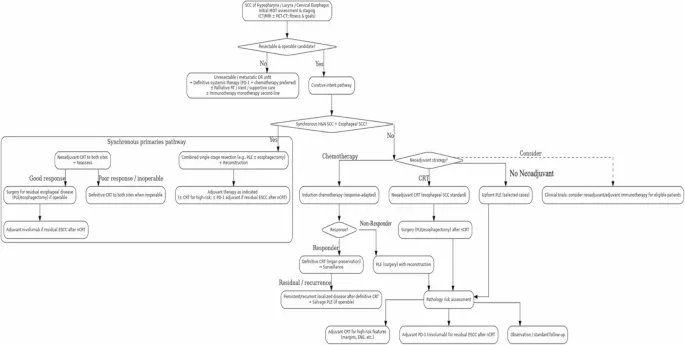
Deze narratieve review beschrijft de ontwikkeling van de pharyngolaryngoesophagectomie bij gevorderde larynx-, hypofarynx- en cervicale oesofaguscarcinoom. Moderne minimaal invasieve en hybride technieken, gecombineerd met neoadjuvante chemoradiatie of immunotherapie, hebben de perioperatieve morbiditeit verminderd en de functionele uitkomsten verbeterd.
Hoewel chemoradiatie vaak eerstelijnsbehandeling is, blijft de operatie essentieel voor geselecteerde patiënten met recidief of lokale progressie, met vijfjaarsoverleving tussen de 20 en 40 procent. De bevindingen onderstrepen de noodzaak van een multidisciplinaire, gepersonaliseerde aanpak waarbij chirurgie wordt ingezet in combinatie met systemische therapie.
Abstract (original)
BACKGROUND: The purpose of this review is to outline the evolution and changing role of pharyngolaryngoesophagectomy (PLE) in the organ-preservation era, and to review advances, including minimally invasive techniques, neoadjuvant therapy, and immunotherapy, and their impact on outcomes in advanced laryngeal, hypopharyngeal, and cervical esophageal cancers. MAIN BODY: A narrative review of the literature from 2000 to the present was performed, focusing on studies of surgical innovations, oncologic outcomes, quality of life, and combined treatment strategies in PLE. Historically, PLE was associated with high morbidity and mortality. However, advances in surgical techniques, reconstructive methods, and perioperative care have significantly improved its safety and functional outcomes. Minimally invasive and hybrid PLE approaches reduce pulmonary complications and speed recovery without compromising oncologic outcomes. Chemoradiation has become the first-line treatment for many advanced cases, with PLE now reserved for selected cervical esophageal tumors or persistent disease after radiation. Neoadjuvant chemotherapy or chemoradiation can shrink tumors, improve operability, and sometimes allow organ preservation. Immunotherapy before surgery improves pathological response rates and disease-free survival. Recent series report 5-year survival of 20-40% after PLE, and most patients regain swallowing and voice function with rehabilitation. CONCLUSION: In the organ-preservation era, PLE remains important for certain advanced or treatment-resistant cases. Its role is defined by a multidisciplinary, personalized approach and limited to cases where surgery is essential, often combined with systemic therapy. Ongoing advances in patient selection, minimally invasive techniques, and immunotherapy are expected to further refine PLE's role and improve outcomes.
Dit artikel is een samenvatting van een publicatie in World journal of surgical oncology. Voor het volledige artikel, alle details en referenties verwijzen wij u naar de oorspronkelijke bron.
Lees het volledige artikelDOI: 10.1186/s12957-026-04519-9