Nieuwe KRAS-remmers en combinatiestrategieën breiden behandelmogelijkheden uit voor KRAS-gemuteerde tumoren
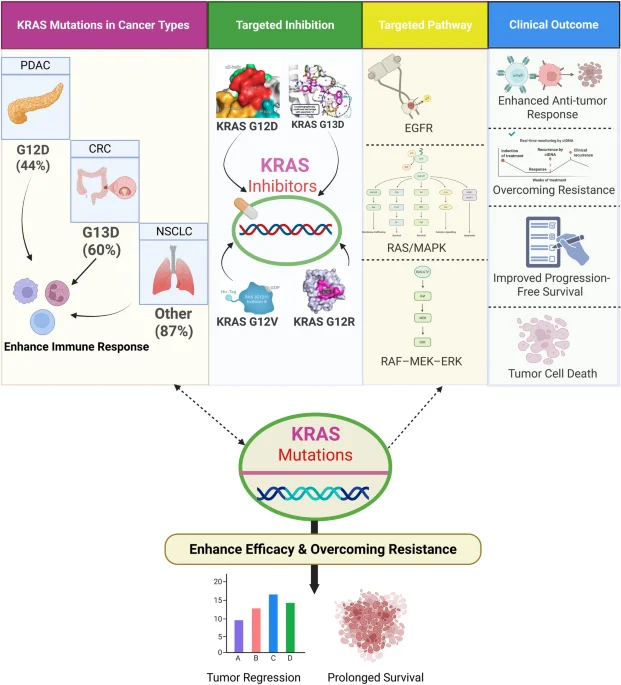
Deze narratieve review vat de recente ontwikkelingen samen in de behandeling van KRAS-gemuteerde maligniteiten, waaronder longkanker, darmkanker en pancreaskanker. Na de validatie van covalente KRAS^G12C-remmers zoals sotorasib en adagrasib, worden nu nieuwe klassen remmers onderzocht, waaronder niet-covalente inhibitoren, pan-RAS-antagonisten en KRAS-gerichte degraders.
De auteurs bespreken ook rationele combinatiestrategieën met SHP2-, SOS1- en MEK-remmers, evenals immuuncheckpointremmers, om resistentie te omzeilen. Deze evolutie markeert een verschuiving van allele-specifieke remming naar contextafhankelijke therapieën, wat klinische vertaalslag en patiëntvoordeel voor nieuwe KRAS-mutaties mogelijk maakt.
Abstract (original)
One of the most commonly mutated oncogenes is Kirsten rat sarcoma viral oncogene homolog (KRAS, which is found in nearly all pancreatic ductal adenocarcinomas (PDAC), is commonly found in colorectal cancers (CRC), and is found in significant numbers in non-small-cell lung cancers (NSCLC). For most of its history, KRAS has been regarded as "undruggable." Still, with recent developments in covalent inhibitors targeting KRAS^G12C, specifically sotorasib and adagrasib, it has now been validated as a viable therapeutic target. Unfortunately, most KRAS mutations occur outside KRAS^G12C and thus require alternative therapeutic strategies beyond those already available. This review summarizes the fast-moving developments in the world of allele-specific and pan-KRAS inhibitors with reference to patent filings, clinical trials, and combinations with other agents. New classes of KRAS inhibitors have recently emerged, including non-covalent inhibitors (MRTX1133, RMC-9805), pan-RAS (ON) antagonists (RMC-6236), and KRAS-directed degraders (ASP3082), as well as planned rational combinations of these new KRAS inhibitors with agents targeting SHP2, SOS1, MEK, and immune checkpoint inhibitors. Other factors, including the development of innovative drug delivery systems, the exploration of resistance mechanisms, and the pursuit of synthetic lethality, could facilitate the complexity of treating KRAS-driven cancers. The regulatory environment and commercialization efforts present opportunities and challenges for precision oncology in KRAS-driven cancers globally. Overall, the rapid evolution of KRAS-targeted therapeutic agents represents a shift from allele-specific inhibition towards a strategy that is mutation/context-dependent, thereby creating further clinical translation opportunities and increased patient benefit.
Dit artikel is een samenvatting van een publicatie in Medical oncology (Northwood, London, England). Voor het volledige artikel, alle details en referenties verwijzen wij u naar de oorspronkelijke bron.
Lees het volledige artikelDOI: 10.1007/s12032-026-03392-6