Combinatie van immuuntherapie en anti-angiogenese verlengt overleving bij niet-kleencellig longkanker
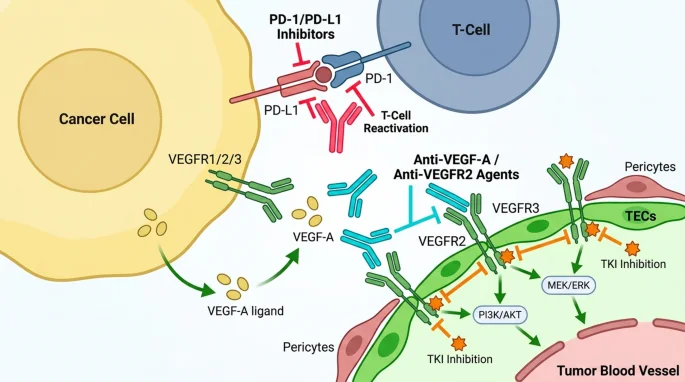
Deze narratieve review synthetiseert preklinische en klinische data tot 2026 over de combinatie van anti-PD-1/PD-L1-remmers en anti-angiogene therapie bij gevorderd niet-kleencellig longkanker. De analyse toont aan dat deze combinatie synergetisch het tumorimmuunmicro-omgeving remodelliert, T-cel-infiltratie versterkt en monotherapieresistentie doorbreekt.
Klinische studies bevestigen een verlenging van de mediane totale overleving met 4,8 maanden, waarbij bispecifieke antilichamen een verbeterd veiligheidsprofiel beloven, met name voor patiënten met comorbiditeiten zoals COPD of longfibrose.
Deze bevindingen onderstrepen de combinatiestrategie als een kernonderdeel van de systemische NSCLC-behandeling en benadrukken de noodzaak van verdere optimalisatie van behandelregimes en real-world veiligheidsmonitoring.
Abstract (original)
Lung cancer remains the leading cause of cancer-related mortality. The 5-year survival rate for advanced non-small cell lung cancer (NSCLC) is only 20%-30%, highlighting an urgent need for more effective therapeutic strategies. Immune checkpoint inhibitors and anti-angiogenic agents are now widely used in clinical practice and have significantly prolonged patient survival. However, their efficacy and safety remain constrained by multiple reasons. This review systematically outlines the synergistic mechanisms and recent advances of combined anti-PD-1/PD-L1 and anti-angiogenic therapy. It also evaluates the clinical value of novel bispecific antibodies in NSCLC, with a specific focus on their potential advantages in patients with comorbidities. By systematically synthesizing preclinical and clinical data from 2020 to 2026, this article analyzes the mechanistic roles of the combination strategy. The clinical efficacy and safety profile are comprehensively assessed. Current evidence demonstrates that combining anti-PD-1/PD-L1 agents with anti-angiogenic therapy synergistically remodels the tumor immune microenvironment. This approach enhances T cell infiltration and function and effectively overcomes monotherapy resistance. Clinical studies have confirmed that this regimen extends median overall survival (mOS) by 4.8 months. Bispecific antibodies developed on this foundation optimize pharmacokinetic matching and improve safety profiles. These single-agent therapies show promising clinical potential for managing NSCLC with chronic obstructive pulmonary disease (COPD) or idiopathic pulmonary fibrosis (IPF). In conclusion, combined therapy has become a pivotal direction in NSCLC systemic treatment. Future research should prioritize optimizing treatment regimens, refining real-world safety assessments, and expanding clinical application in patients with complex comorbidities to address current unmet therapeutic needs.
Dit artikel is een samenvatting van een publicatie in Current treatment options in oncology. Voor het volledige artikel, alle details en referenties verwijzen wij u naar de oorspronkelijke bron.
Lees het volledige artikelDOI: 10.1007/s11864-026-01412-1