Intensieve chemotherapie bij oligometastatisch mammacarcinoom met HRR-defect
Studie bij geselecteerd oligometastatisch mammacarcinoom.
Abstract (original)
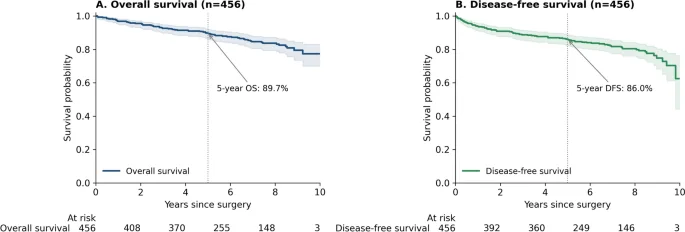
BACKGROUND: Oligometastatic breast cancer (OMBC) is a clinical entity with a prospect of long-term survival, but uncertainty remains on its optimal treatment. We studied whether intensified alkylating chemotherapy (IACT) improves long-term outcome compared to conventional-dose chemotherapy (CDCT) as part of a multimodality approach for patients with OMBC harboring homologous recombination deficiency (HRD). PATIENTS AND METHODS: Eligible patients had HER2-negative OMBC, harboring HRD, with ≤ 3 distant metastases, pathologic proof of distant disease and a favorable response to three cycles CDCT. Participants were randomized 1:1 to continue with either CDCT or IACT. IACT consisted of one mobilization course followed by two cycles of mini-CTC (carboplatin, thiotepa and cyclophosphamide) supported by peripheral blood progenitor cell reinfusion. Primary outcome was event-free survival (EFS). Secondary endpoints included overall survival (OS), quality of life and safety. RESULTS: Seventy-five patients were randomized to either IACT (n = 36) or CDCT (n = 39). Twenty-three (31 %) patients had hormone receptor-positive disease and 52 (69 %) had triple-negative disease. Median EFS in the IACT-group was 28 months (95 % confidence interval [CI] 21-not reached [NR]) versus 25 months (95 %CI 14-NR) in the CDCT-group (hazard ratio [HR] for recurrence or death 0.78, 95 %CI 0.42-1.42). Median OS was 67 months (95 %CI 37-NR) in the IACT-group and 36 (95 %CI 26-NR) in the CDCT-group (HR 0.74, 95 %CI 0.37-1.48). CONCLUSIONS: The entire study population experienced long-term survival, with median OS well over five years. IACT compared to CDCT did not improve outcome in patients with OMBC harboring study-defined HRD. The optimal therapy for patients with OMBC requires further study. TRIAL REGISTRATION: ClinicalTrials.gov: NCT01646034.
Dit artikel is een samenvatting van een publicatie in European journal of cancer (Oxford, England : 1990). Voor het volledige artikel, alle details en referenties verwijzen wij u naar de oorspronkelijke bron.
Lees het volledige artikelDOI: 10.1016/j.ejca.2024.115083